 Cup & Ratio
In pictures
One chart calculates the coffee cost of a cup at home
The price of a bag becomes easier to compare when you connect it to dose.

Before you start
The price of a bag becomes easier to compare when you connect it to dose. This calculation covers beans only unless you explicitly add other costs.
Convert the bag into a cost per gram
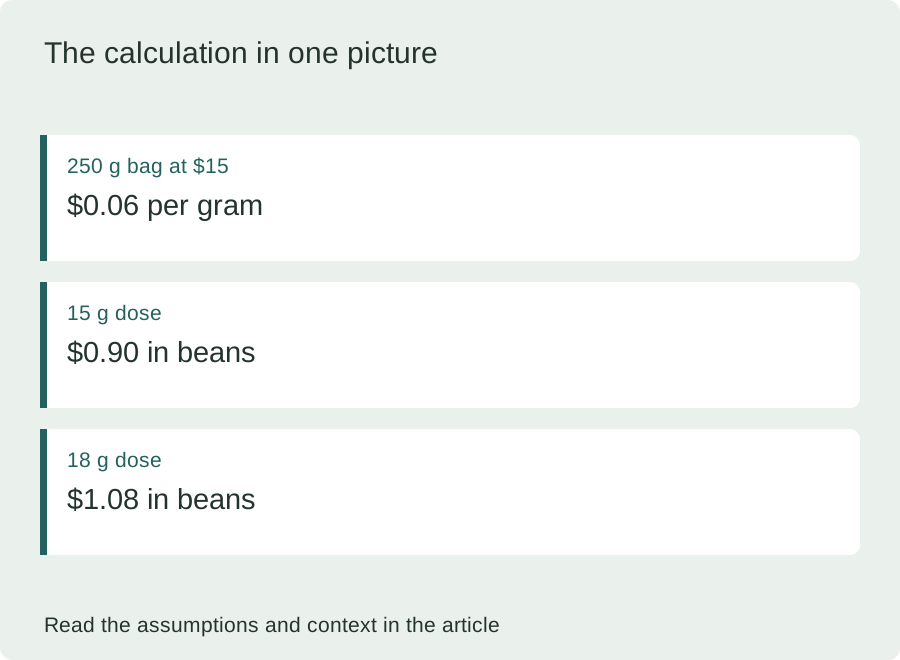
Suppose a hypothetical 250 g bag costs $15. Divide 15 by 250 to get $0.06 per gram. Keep the currency and mass units consistent. A sale price, shipping charge or different bag size changes the calculation, so use the actual amount relevant to your purchase.
Multiply by the dry dose
At $0.06 per gram, a 15 g dose uses $0.90 of coffee, an 18 g dose $1.08 and a 20 g dose $1.20. These examples describe bean cost for the stated doses. They do not say how many people the resulting beverage serves or whether one recipe is better value to you.
Account for usable coffee honestly
Spilled, purged or otherwise unused coffee affects the cost per served drink. For a more complete record, divide the bag cost by the actual drinks served from it. Keep that observed figure separate from a theoretical maximum based on perfect use. Neither figure is a universal estimate of home coffee costs.
Compare bag sizes on the same basis
A hypothetical 250 g bag at $15 costs $0.06 per gram. A 340 g bag at $18 costs about $0.0529 per gram, giving a bean cost of about $0.95 for an 18 g dose. That comparison uses the listed example prices only and excludes shipping and unused coffee. A larger bag is not automatically better for you if it changes how much you leave unused or prevents you from buying the coffee you prefer. Keep the arithmetic transparent, then consider the practical purchase. Price per gram is a comparison tool, not a complete account of value.
State the costs you excluded
Milk, filters, water, energy, equipment and maintenance are absent from the simple bean calculation. Add categories only when you can define and measure them reasonably. Avoid comparing a bean-only figure directly with a cafe price as though the two covered the same service and costs.
Practical check: what to observe
Work through the numbers using the stated units. The examples are illustrative; changing an input or an assumption can change what the result means.
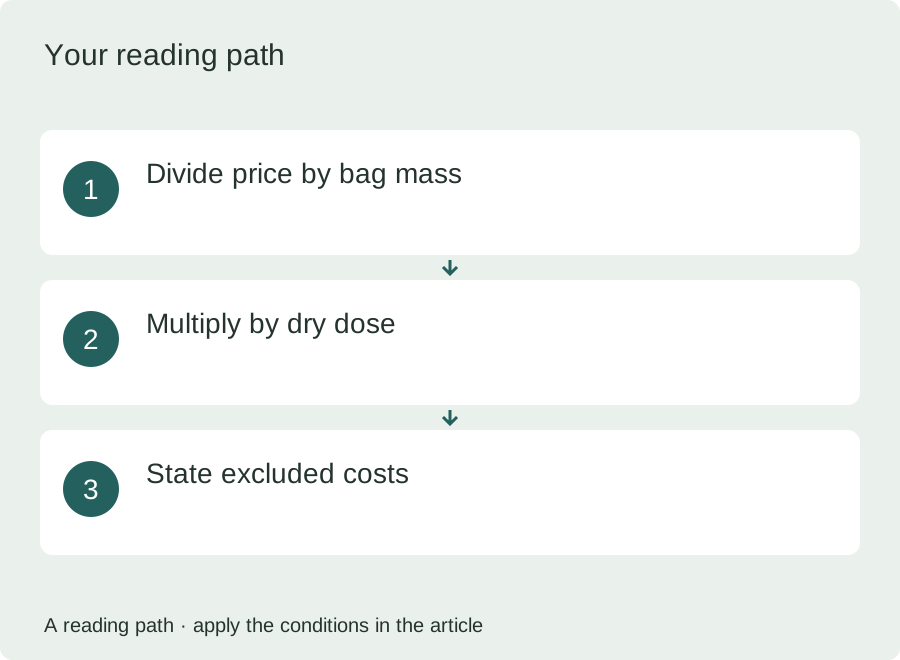
- Divide price by bag mass
- Multiply by dry dose
- State excluded costs
Does this show that a home machine will pay for itself?
No. That requires assumptions about equipment, maintenance, usage, alternatives and time. This article only demonstrates transparent bean-cost arithmetic.
For more context, see the topic FAQ and glossary. A reference value or example should be read with its units, assumptions and product-specific conditions.
Sources and scope
The numerical examples use the arithmetic and assumptions shown in the article. They are hypothetical illustrations, not measurements of a tested product. Read the editorial policy for sourcing, AI assistance and corrections.
Put the explanation to work
Continue reading
Spot a questionable claim or a calculation issue? Read our correction process and contact information. Examples and illustrations are educational; they do not establish product suitability or a laboratory result.