 Cup & Ratio
Water Chemistry & Mineral Buffers
Espresso scale: water tests and descaling decisions
A kettle deposit is a clue that minerals can precipitate, not a complete diagnosis of the inside of an espresso machine.

Before you start
A kettle deposit is a clue that minerals can precipitate, not a complete diagnosis of the inside of an espresso machine. Boiler temperature, repeated concentration and materials affect behavior. Check the machine’s water specifications and maintenance instructions before choosing treatment or descaling.
Every commercial espresso technician and home dual-boiler owner faces a fundamental materials-science paradox: the exact same minerals required to extract balanced, sweet espresso and buffer harsh organic acids—divalent hardness cations (Ca²⁺, Mg²⁺) and bicarbonate alkalinity (HCO₃⁻)—can also precipitate inside a 93°C brew boiler or 125°C steam boiler as rock-hard calcium carbonate limescale (CaCO₃), clogging 0.6 mm ruby flow restrictors (gicleurs), seizing solenoid valves, and insulating heating elements until they burn out.
Conversely, feeding an espresso machine pure distilled or zero-TDS Reverse Osmosis (RO) water creates an aggressive, ion-hungry solvent that leaches lead, zinc, and copper out of brass fittings, triggers pitting corrosion in stainless steel, and prevents water-level conductivity probes from sensing when the steam boiler is full! You can evaluate your water’s exact scaling vs. corrosion balance in our Coffee Water Chemistry (GH/KH) & Grind Micron Matrix.
1. Retrograde Solubility: Why Heating Water Precipitates Limescale
Almost all common household solids (sucrose, sodium chloride, citric acid) dissolve more readily in boiling water than in cold water because their dissolution is endothermic (Δ H_soln > 0). Calcium carbonate (CaCO₃) is a famous thermodynamic exception: its dissolution is exothermic (Δ H_soln < 0), meaning it exhibits retrograde (inverse) solubility—the hotter the water gets, the less CaCO₃ can stay dissolved!
Inside an espresso boiler or heat-exchanger (HX) tube, a second powerful chemical mechanism accelerates scale precipitation. When cold reservoir water containing dissolved calcium ions (Ca²⁺) and bicarbonate ions (HCO₃⁻) contacts a 125°C heating element sheath, thermal decomposition converts two bicarbonate ions into one carbonate ion (CO₃²⁻), water, and a bubble of carbon dioxide gas:
Ca²⁺ (aq) + 2HCO₃⁻ (aq) --[Δ Heat (93°C–125°C)]--> CaCO₃↓ (s, scale) + CO₂↑ (g) + H₂O (l)Because the solubility product constant (K_sp) of calcite/aragonite drops by nearly an order of magnitude between 20°C (K_sp ≈ 3.3 × 10^-9) and 100°C (K_sp ≈ 4.0 × 10^-10), and because escaping CO₂ gas shifts the equilibrium to the right via Le Chatelier’s principle, crystal nucleation begins immediately on the hottest metal surfaces in the machine: heating element coils, thermosyphon restrictors, and 3-way grouphead solenoid seats.
2. The Langelier Saturation Index (LSI) at 93°C
To quantify whether a water recipe will deposit CaCO₃ scale or dissolve metal oxides at brewing temperature, water engineers calculate the Langelier Saturation Index (LSI):
LSI = pH_actual - pH_sHere, pH_actual is the measured pH of the water, and pH_s (saturation pH) is the theoretical pH at which water of a given calcium hardness ([Ca²⁺]_CaCO₃), carbonate alkalinity (KH_CaCO₃), total dissolved solids (TDS), and temperature (T, in Kelvin) is in exact thermodynamic equilibrium with solid CaCO₃:
pH_s = (9.3 + A + B) - (C + D)Where the empirical Langelier coefficients are:
A = \frac{log10(TDS_mg/L) - 1}{10}(ionic strength correction, typically≈ 0.10)B = -13.12 × log10(T_Kelvin) + 34.55(temperature factor: drops from2.02at25°Cdown to0.78at93°C, making hot water1.24 LSI unitsmore scale-forming than cold water!)C = log10([Ca²⁺]_ppm as CaCO₃) - 0.40(calcium hardness driving force)D = log10(KH_ppm as CaCO₃)(alkalinity driving force)
Interpreting LSI at 93°C Brew Boiler Temperature:
LSI < -0.6: Aggressive/corrosive water; dissolves protective passive oxide films and leaches brass/copper ions.-0.5 ≤ LSI ≤ +0.2: Optimal Non-Scaling Specialty Zone; stable passivated metal surfaces with zeroCaCO₃precipitation.LSI > +0.3: Supersaturated withCaCO₃; progressive limescale deposition on heating elements and flow restrictors.
3. Why Magnesium-Dominant Water Prevents Espresso Boiler Scale
Notice in the Langelier equation above that coefficient C depends strictly on Calcium Hardness ([Ca²⁺]), NOT on Magnesium Hardness ([Mg²⁺])!
Why doesn’t magnesium precipitate as scale at 93°C? At brew boiler temperatures (90–96°C) and normal water alkalinity (KH = 35–50 ppm as CaCO₃), magnesium carbonate (MgCO₃, solubility ≈ 100–400 mg/L) is more than 20 times more soluble than calcium carbonate (CaCO₃, solubility ≈ 5–13 mg/L)!
By building your espresso brew water using Magnesium Sulfate (MgSO₄ · 7H₂O, Epsom salt) for 75%–100% of your General Hardness (GH = 55–70 ppm as CaCO₃) and pairing it with 40–45 ppm as CaCO₃ of Sodium or Potassium Bicarbonate (see DIY Remineralized Coffee Water Recipes), you achieve full divalent cation extraction power and full acid buffering while keeping calcium scale saturation (LSI) strictly negative!
4. Comparing Descaling Acids: Citric vs. Sulfamic vs. Lactic Acid
When an espresso machine has already accumulated CaCO₃ scale from hard tap water, choosing the right organic or inorganic acid for chemical descaling is critical to avoid secondary precipitation or seal damage:
| Descaling Acid | Recommended Concentration | Reaction Speed on CaCO₃ (60°C) |
Secondary Precipitate Risk | Brass / Copper / Nickel Safety | Best Use Case & Warnings |
|---|---|---|---|---|---|
1. Sulfamic Acid (H_3NSO₃) |
1.5%–3.0% w/v (15–30 g/L) |
Very Fast (pK_a = 1.0, strong acid) |
Zero (Calcium sulfamate is ultra-soluble: 600+ g/L) |
Safe with corrosion inhibitors (< 65°C) |
Gold standard for heavy commercial/prosumer descaling. Dissolves both CaCO₃ and Mg(OH)_2 rapidly without leaving residue. |
2. Citric Acid (C_6H_8O_7) |
2.5%–4.0% w/v (25–40 g/L) |
Moderate (pK_a1 = 3.13) |
Moderate at > 75°C (Insoluble calcium citrate can precipitate if concentrated!) |
Mildly strips nickel plating if soaked > 2 hrs |
Safe, food-grade household descaler for kettles and light maintenance; keep solution below 65°C to prevent white calcium citrate crust! |
3. Lactic Acid (C_3H_6O₃) |
3.0%–5.0% w/v (Liquid solution) |
Moderate (pK_a = 3.86) |
Very Low (Calcium lactate is highly soluble in warm water) | Gentle on aluminum, brass, and EPDM/silicone | Ideal for thermoblock and aluminum-boiler home machines where strong mineral acids can pit aluminum walls. |
| 4. Acetic Acid (Household Vinegar) | Do Not Use | Slow (pK_a = 4.76) |
Low | Attacks natural rubber gaskets and copper | Never use vinegar in espresso boilers: acetic acid odor absorbs into silicone tubing and EPDM seals for weeks! |
Practical check: what to observe
Record the water source and measured hardness and alkalinity with units. Do not substitute a conductivity TDS reading for those values. If flow or heating changes, consider professional service; dissolving deposits can release particles into narrow passages.
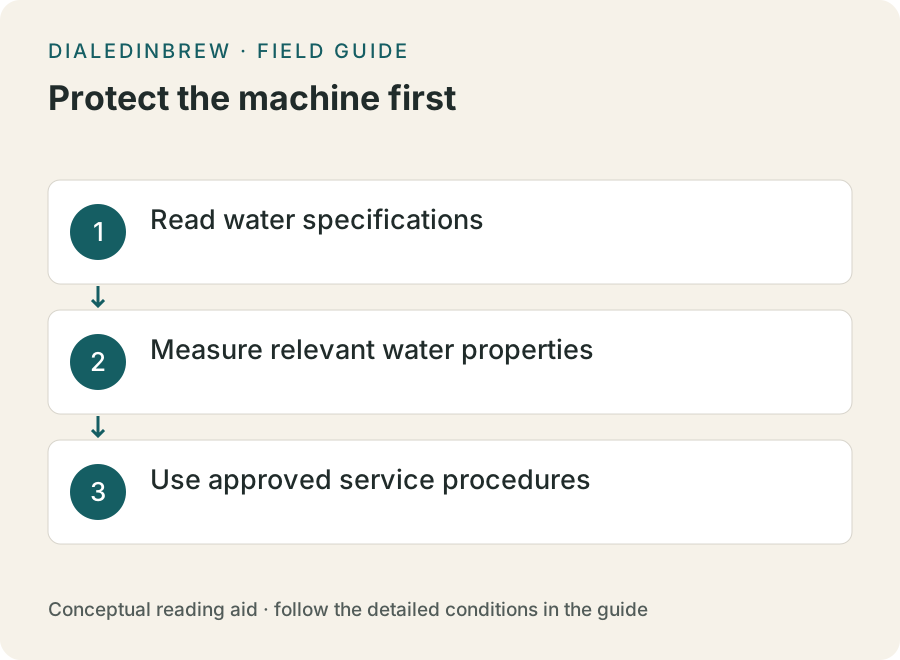
- Read water specifications
- Measure relevant water properties
- Use approved service procedures
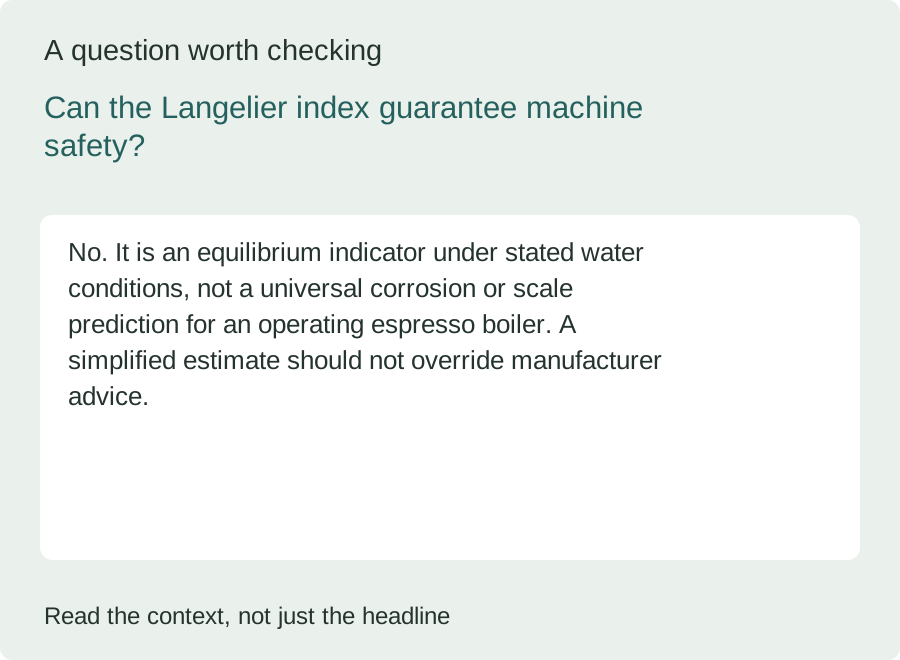
Can the Langelier index guarantee machine safety?
No. It is an equilibrium indicator under stated water conditions, not a universal corrosion or scale prediction for an operating espresso boiler. A simplified estimate should not override manufacturer advice.
For more context, see the topic FAQ and glossary. A reference value or example should be read with its units, assumptions and product-specific conditions.
Sources and scope
The references below were supplied with the original manuscript. A reference is not evidence that every numerical claim has been independently checked. See the source library and our verification status.
- Langelier – The Analytical Control of Anti-Corrosion Water Treatment (Journal of the American Water Works Association)
- Plummer & Busenberg – The solubilities of calcite, aragonite and vaterite in CO2-H2O solutions between 0 and 90°C (Geochimica et Cosmochimica Acta)
- APHA Standard Method 2330 – Calcium Carbonate Saturation & Langelier Index Calculation
Put the explanation to work
Continue reading
Spot a questionable claim or a calculation issue? Read our correction process and contact information. Examples and illustrations are educational; they do not establish product suitability or a laboratory result.