 Cup & Ratio
Water Chemistry & Mineral Buffers
Coffee water: hardness vs alkalinity
A water report can list calcium, magnesium, hardness and alkalinity in different forms.
Before you start
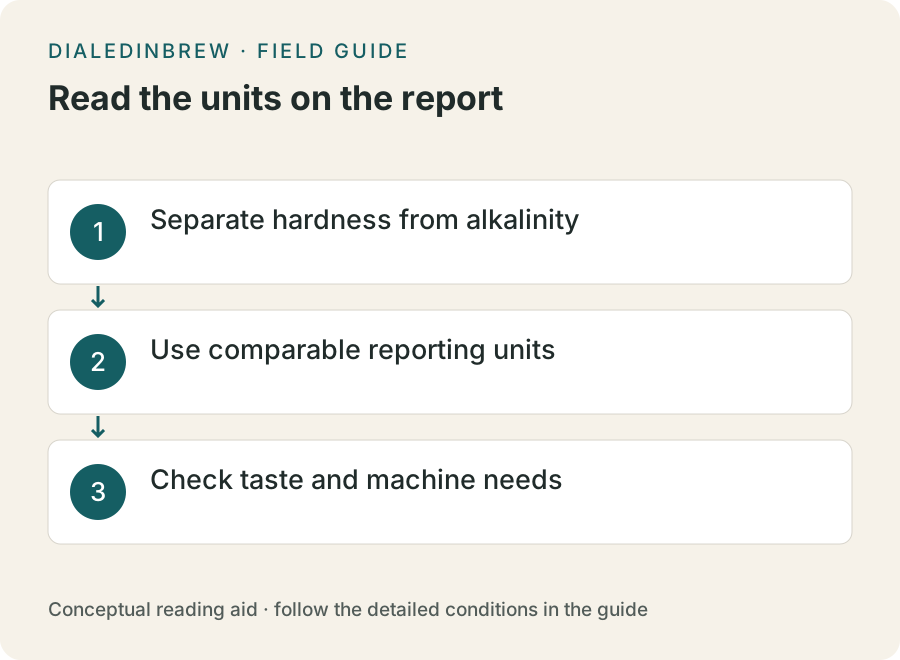
A water report can list calcium, magnesium, hardness and alkalinity in different forms. Values reported as calcium carbonate equivalents are a common comparison basis, but they are not the same as the mass of each dissolved mineral. Read the units before entering a calculator.
Because filter coffee is roughly 98.6% water and espresso is roughly 90% water, the dissolved mineral composition of your brew water governs two separate chemical processes: first, how efficiently water solvates and pulls aromatic and acidic molecules out of the roasted cellulose matrix during brewing; and second, how much of the extracted organic acid remains dissociated as free hydrogen ions (H⁺) on your tongue when you taste the cup.
Two water sources can share the exact same Total Dissolved Solids (TDS) reading on a handheld conductivity pen—say, 110 mg/L—yet produce wildly different cups of coffee. One water might make a washed Kenyan SL28 taste electric, juicy, and blackcurrant-sweet, while the other renders the exact same beans flat, chalky, and papery. The secret lies in separating General Hardness (GH) from Carbonate Alkalinity (KH). You can calculate your exact mineral balance using our Coffee Water Chemistry (GH/KH) & Grind Micron Matrix.
1. Why Water Chemists Express Everything “as CaCO₃”
Before diving into extraction chemistry, we have to resolve the single most common source of unit confusion in coffee water: “ppm as CaCO₃ equivalents.”
Different dissolved ions have different molar masses. A single magnesium ion (Mg²⁺) has a molar mass of 24.305 g/mol, whereas a calcium ion (Ca²⁺) has a molar mass of 40.078 g/mol, and a bicarbonate ion (HCO₃⁻) has a molar mass of 61.017 g/mol. If you have 10 mg/L of Mg²⁺ ions in water and 10 mg/L of Ca²⁺ ions, you actually have 1.65 times as many magnesium ions per liter as calcium ions!
To compare reactive charge equivalents on a 1-to-1 stoichiometric scale, hydrologists normalize both divalent cations and carbonate buffers to the molar mass of calcium carbonate (CaCO₃, molar mass = 100.087 g/mol, equivalent weight = 50.04 g/eq):
1.00 mg/Lof elementalMg²⁺= (100.087) / (24.305) = 4.12 ppm as CaCO₃1.00 mg/Lof elementalCa²⁺= (100.087) / (40.078) = 2.50 ppm as CaCO₃1.00 mg/Lof bicarbonate (HCO₃⁻)= (50.043) / (61.017) = 0.82 ppm as CaCO₃
Whenever the Specialty Coffee Association (SCA) or a titration test kit reports GH = 70 ppm and KH = 40 ppm, both numbers are expressed in mg/L as CaCO₃ equivalents (note that 1 German degree (°dH) = 17.848 ppm as CaCO₃).
2. General Hardness (GH): Mg²⁺ vs. Ca²⁺ Extraction Kinetics
General Hardness (GH) is the sum of divalent alkaline earth metal cations dissolved in water—overwhelmingly magnesium (Mg²⁺) and calcium (Ca²⁺):
GH (ppm as CaCO₃) = 4.12 × [Mg²⁺]_mg/L + 2.50 × [Ca²⁺]_mg/LComputational density functional theory (DFT) modeling by Hendon, Colonna-Dashwood, and Walsh (2014) demonstrated that dissolved Mg²⁺ and Ca²⁺ ions actively assist water in extracting flavor-active molecules from roasted coffee through electrostatic coordination:
- Magnesium (
Mg²⁺) has a smaller ionic radius and higher charge density. It coordinates strongly with oxygen-dense functional groups found in small, volatile aromatic aldehydes, esters, and fruit-forward organic acids (citric, malic, and lactic acids). Water with a higherMg²⁺:Ca²⁺ratio emphasizes crisp, defined top-note aromatics and fruit clarity. - Calcium (
Ca²⁺) has a larger ionic radius that bridges larger polarizable molecules and phenolic structures, enhancing perceived creamy body, mouthfeel weight, and chocolate/caramel roundness, while also posing a major limescale precipitation risk inside espresso boilers when paired with bicarbonate (see Espresso Boiler Scale Chemistry & Langelier Index).
If GH is too low (GH < 25 ppm as CaCO₃), water lacks the ionic binding capacity to pull sufficient sweet and aromatic compounds out of the grounds, leaving the cup thin, sharp, and hollow. Conversely, if GH exceeds 130 ppm as CaCO₃, excessive cation binding pulls heavy, muddy chlorogenic acid lactones and polyphenols into the brew.
3. Carbonate Alkalinity (KH): The Bicarbonate Proton Sponge
While GH alters what is extracted from the coffee grounds, Carbonate Alkalinity (KH) directly alters how the extracted acids behave in the cup through acid-base equilibrium. Across the pH range of natural drinking water (pH 6.5–8.2), virtually all carbonate alkalinity exists as the bicarbonate ion (HCO₃⁻).
Roasted coffee contains a rich spectrum of weak organic acids—including citric, malic, quinic, acetic, phosphoric, and chlorogenic acids (HA). When these acids dissolve in water, they partially dissociate into conjugate base anions (A^-) and free hydronium ions (H₃O⁺), which our taste buds perceive as bright, vibrant fruit acidity:
HA (aq) + H₂O (l) ⇌ H₃O⁺ (aq) + A^- (aq)When bicarbonate ions (HCO₃⁻) are present in the brew water, they react with free H₃O⁺ ions to form carbonic acid (H₂CO₃), which rapidly decomposes at brewing temperatures into dissolved carbon dioxide gas (CO₂) and water:
HCO₃⁻ (aq) + H₃O⁺ (aq) ⇌ H₂CO₃ (aq) + H₂O (l) ⟶ CO₂↑ (g) + 2H₂O (l)Notice that this reaction permanently consumes free H₃O⁺ ions while leaving the conjugate base anions (A^-, such as citrate or malate salts) behind in solution! Because the human tongue perceives sourness/brightness primarily from both titratable acidity and free proton concentration, high bicarbonate alkalinity (KH > 75 ppm as CaCO₃) neutralizes the sparkling fruit acids of high-grown coffees and replaces them with dull, earthy, or salty-chalky organic salts.
4. How GH and KH Map to Cup Sensory Profiles
The table below maps common municipal and custom water mineral profiles against their chemical Residual Alkalinity (RA = KH - [Ca²⁺/3.5 + Mg²⁺/7]) and sensory impact on a light-to-medium specialty roast:
| Water Profile Archetype | GH (ppm CaCO₃) |
KH (ppm CaCO₃) |
Residual Alkalinity (RA) |
Typical Brew pH |
Sensory & Extraction Outcome |
|---|---|---|---|---|---|
| Distilled / Ultra-Pure RO | 0–5 ppm |
0–2 ppm |
≈ 0 ppm |
4.78–4.85 |
Unbuffered, aggressive vinegar-like sourness; hollow body; poor aromatic extraction. |
| Ultra-Light Nordic Filter Water | 50 ppm |
20 ppm |
+8 ppm |
4.90–4.96 |
High-definition florals and sparkling citrus/berry acidity; delicate tea-like structure. |
| SCA Balanced Specialty Target | 70 ppm |
40 ppm |
+25 ppm |
5.02–5.10 |
Balanced sweetness and acidity; integrated stone-fruit brightness with syrupy finish. |
| Espresso-Safe Non-Scaling Profile | 60 ppm (Mg-dominant) |
45 ppm |
+35 ppm |
5.08–5.14 |
Tames intense espresso organic acids without forming CaCO₃ scale in steam boilers. |
| Hard Municipal Tap (Limestone) | 180 ppm |
135 ppm |
+88 ppm |
5.35–5.50 |
Acid buffer overwhelms fruit notes; cup tastes flat, chalky, baked, and cardboard-dry. |
| Softened Sodium-Exchange Water | 5 ppm |
140 ppm |
+138 ppm |
5.45–5.60 |
Worst possible combination: zero Ca²⁺/Mg²⁺ extraction power plus massive alkalinity buffer. |
5. Why Domestic Ion-Exchange Water Softeners Ruin Coffee
Look closely at the bottom row of the table above. When a household installs a traditional salt-based ion-exchange water softener to treat hard limestone tap water (GH = 180 ppm, KH = 135 ppm), the resin beads swap divalent Ca²⁺ and Mg²⁺ ions for monovalent sodium ions (Na⁺).
While GH drops to nearly 0 ppm—preventing limescale inside hot water heaters—the resin beads do not touch the negatively charged bicarbonate (HCO₃⁻) ions! You are left with water that has 0 ppm of flavor-extracting magnesium and calcium, coupled with 135+ ppm of acid-destroying bicarbonate alkalinity. Brewing specialty coffee with sodium-softened tap water produces a flat, woody, savory cup. To build custom brew water with complete control over GH and KH, follow our step-by-step protocol in DIY Remineralized Coffee Water Recipes Using Epsom Salt and Sodium Bicarbonate.
Practical check: what to observe
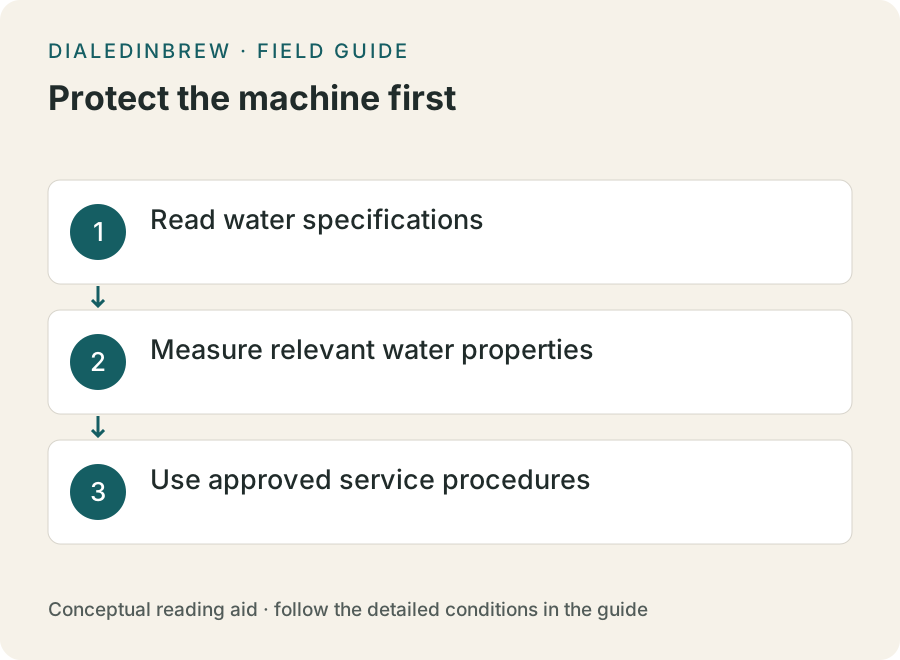
Measure or obtain both hardness and alkalinity when possible and record the test method. Compare cups with the same coffee recipe. Treat water chosen for flavor and water approved for a particular machine as related but separate requirements.
- Separate hardness from alkalinity
- Use comparable reporting units
- Check taste and machine needs
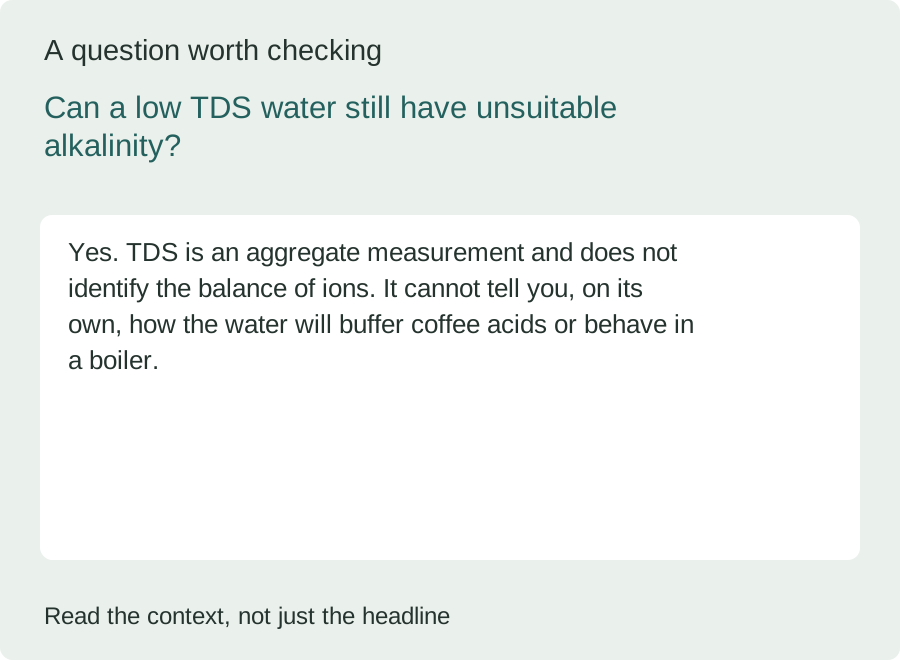
Can a low TDS water still have unsuitable alkalinity?
Yes. TDS is an aggregate measurement and does not identify the balance of ions. It cannot tell you, on its own, how the water will buffer coffee acids or behave in a boiler.
For more context, see the topic FAQ and glossary. A reference value or example should be read with its units, assumptions and product-specific conditions.
Sources and scope
The references below were supplied with the original manuscript. A reference is not evidence that every numerical claim has been independently checked. See the source library and our verification status.
- Hendon, Colonna-Dashwood & Walsh – The Role of Dissolved Cations in Coffee Extraction (Journal of Agricultural and Food Chemistry)
- Colonna-Dashwood & Hendon – Water for Coffee: Science Story (Specialty Coffee Chemistry Monograph)
- Specialty Coffee Association (SCA) – Water Quality Handbook & Standard 310-2023
Put the explanation to work
Continue reading
Spot a questionable claim or a calculation issue? Read our correction process and contact information. Examples and illustrations are educational; they do not establish product suitability or a laboratory result.