 Cup & Ratio
Explainers
Coffee books from your first good cup to brewing physics
Choose a practical home-coffee book or a deeper scientific reference, then pair your reading with one repeatable brewing question.

Before you start
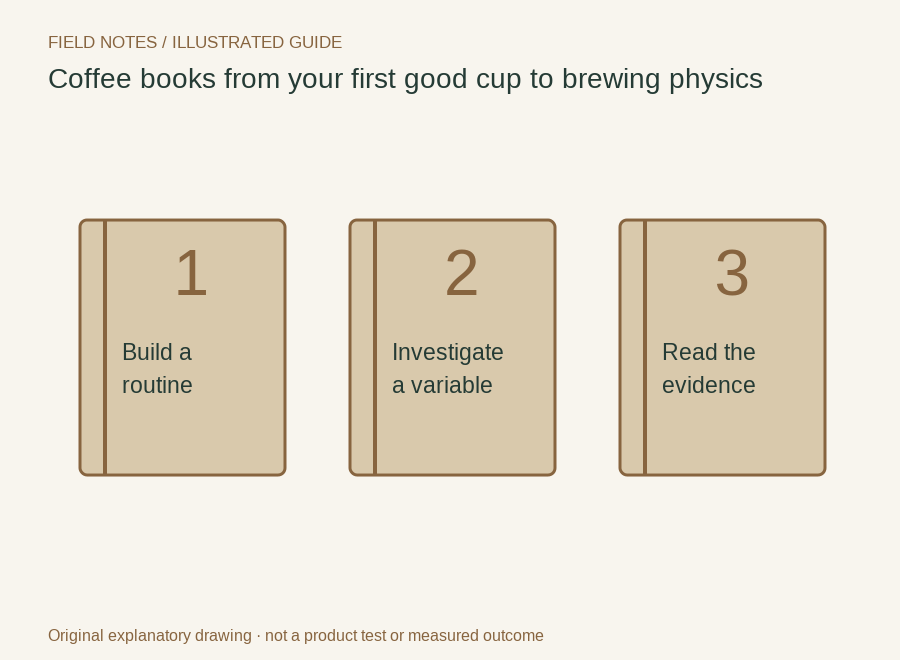
Start with practical instruction when you need a repeatable cup; choose a deeper reference when you have a specific brewing question to investigate. This reading path compares the scope described by publishers and authors, rather than claiming a complete review of each book.
Pick the kind of answer you need
“I want a reliable morning routine” and “I want to understand why this filter stalls” call for different reading. A practical guide can help establish a baseline. A technical reference becomes more useful once you can describe the variable that puzzles you.
Before buying a book, look for an authorized sample or contents list and compare it with your question. The best first book for you is the one you can turn into a useful action, not necessarily the most technical title.
Two starting points
James Hoffmann’s How to Make the Best Coffee at Home covers domestic equipment, grinding and brewing methods according to its publisher. It is a practical entry point for organizing a home setup.
Jonathan Gagné’s The Physics of Filter Coffee addresses percolation, extraction, grinding and water chemistry. His Coffee ad Astra website also provides public articles and analytical tools. The author’s scientific background does not turn every home observation into a universal result; read the conditions and limitations of each explanation.
Give each resource a different job
| Resource | Use it for | Do not assume |
|---|---|---|
| Practical brewing book | Establishing a repeatable routine | A grinder number transfers to your machine |
| Scientific reference | Understanding variables and mechanisms | An idealized model captures every brew |
| Author’s experiment or blog | Examining a particular method or observation | One experiment establishes a universal winner |
| Research project or paper | Checking methods and measured outcomes | A headline tells you the whole study |
The Coffee Science Foundation’s brewing project provides a route into research connected with UC Davis Coffee Center. Follow through to individual publications when you need a precise result.
Build a reading-to-brewing notebook
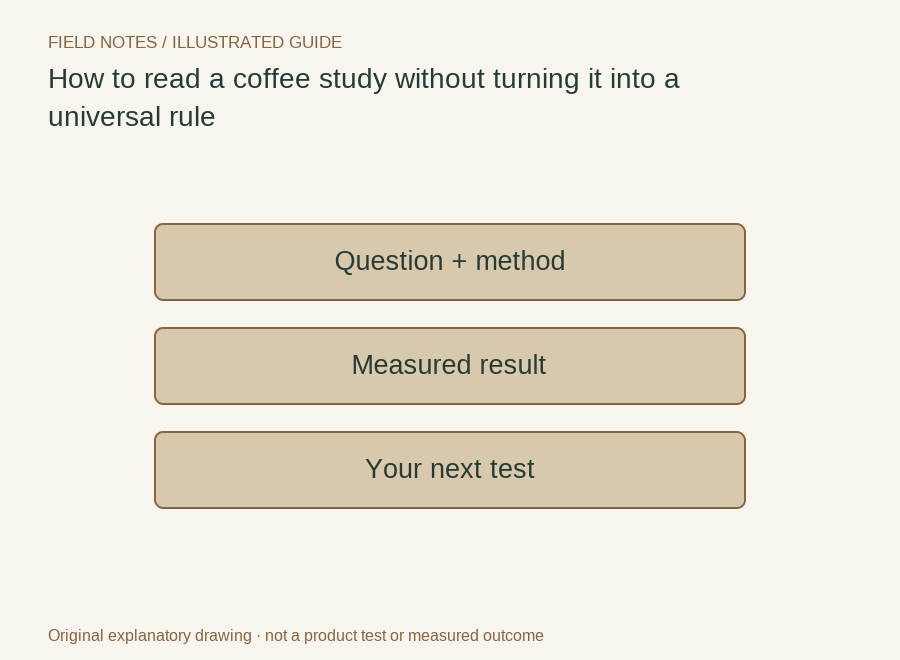
Use four fields: question, source, proposed change and observed result. Keep the source’s claim separate from your own interpretation. If a book explains a variable, that does not mean it supplied the exact recipe you later devised.
For an example, your question might be whether a different dose suits your preferred cup size. Use our coffee ratio calculator to make the arithmetic explicit. Record both coffee mass and added water; “one scoop” leaves an important part of the setup unknown.
Do not skip the baseline
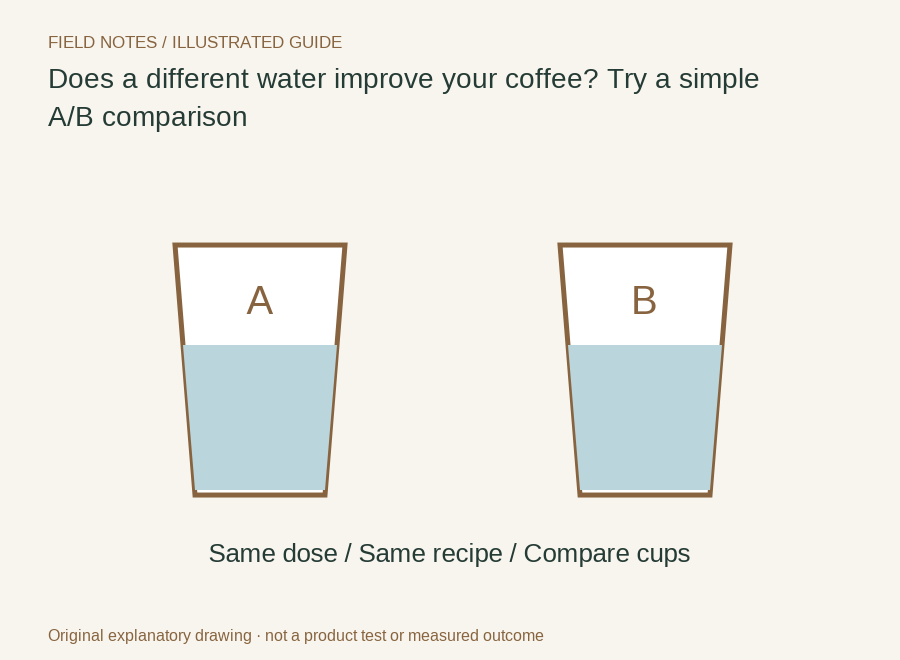
Before changing a variable, prepare a cup using the routine you already know and write down the steps. This gives the next cup a meaningful comparison. If you change the water, grind, filter and pouring style together, the result may be enjoyable but cannot isolate the contribution of one change.
Our brew journal guide offers a compact format. You do not need to track every possible variable at once; record the ones relevant to the question.
Let reading reduce uncertainty
A useful next step can be modest: a clearer recipe card, a better measurement, or the decision to stop changing something that already works. There is no requirement to purchase all the equipment pictured in a book or video.
Keep a list of unresolved questions for later. A reference library grows more useful when each source has an identifiable purpose.
Practical check: what to observe
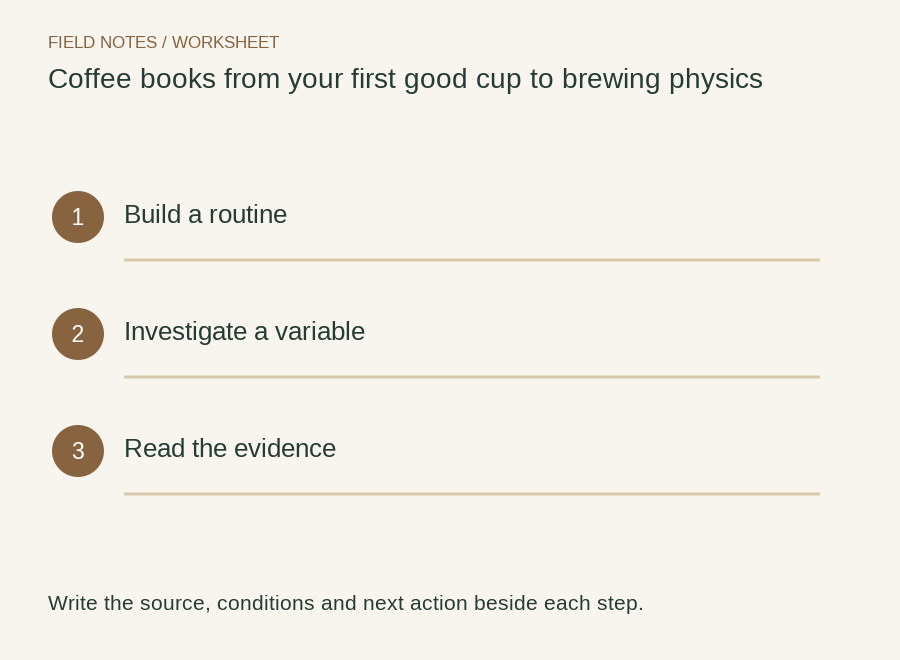
Write one brewing question before reading. Afterward, record one change you can test with the equipment you own and one uncertainty that the source does not resolve.
- Build a routine
- Investigate a variable
- Read the evidence
Do I need a refractometer to benefit from a scientific coffee book?
No. You can learn to distinguish quantities, recognize assumptions and record a controlled comparison without measuring extraction yield. Do not invent a TDS or extraction value when you have not measured it.
For more context, see the topic FAQ and glossary. A reference value or example should be read with its units, assumptions and product-specific conditions.
Sources and scope
The reading below provides context for the relevant care or brewing principles. The article’s scenarios and decision questions are original editorial explanations, not independent product tests. Read the editorial policy for sourcing, AI assistance and corrections.
- James Hoffmann — How to Make the Best Coffee at Home
Publisher description establishes topics covered; no invented chapter or page citations.
- Jonathan Gagné — The Physics of Filter Coffee
Book page linked by the author; scope information rather than a complete review.
- Jonathan Gagné — Coffee ad Astra
Author background and access to articles, experiments and tools; claims are assessed individually.
- Coffee Science Foundation — Brewing Fundamentals
Project overview with UC Davis Coffee Center; precise study claims require the individual publication.
Put the explanation to work
Continue reading
Spot a questionable claim or a calculation issue? Read our correction process and contact information. Examples and illustrations are educational; they do not establish product suitability or a laboratory result.