 Cup & Ratio
Grind Particle Physics & Burr Geometry
Flat and conical burrs: what comparisons can tell you
Burr geometry is only one part of a grinder.
Before you start
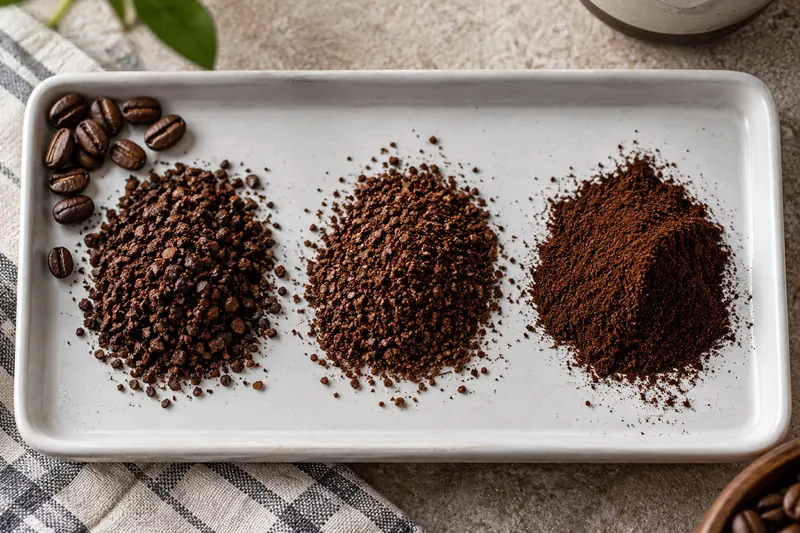
Burr geometry is only one part of a grinder. Alignment, burr design, wear, speed and adjustment all influence the grounds and the experience of using it. Two settings marked the same number are not comparable, and a single median particle size does not describe the whole distribution.
When you adjust the collar on a coffee grinder, you are not cutting roasted coffee beans into uniform spheres of a single diameter. Instead, brittle fracture of the porous, cellular roasted coffee matrix always generates a Particle Size Distribution (PSD) spanning more than three orders of magnitude—from sub-10 µm cell-wall fragments up to 1,200 µm multi-cellular boulders.
Whether a grinder is described as producing a bimodal or unimodal distribution—and whether it uses conical or flat burrs—directly controls the hydraulic permeability of your espresso puck or pour-over bed, the speed at which solubles diffuse into water, and the balance between syrupy body and high-definition flavor clarity. You can explore target median grind sizes (D_50) and fines fractions across brew methods in our Coffee Water Chemistry (GH/KH) & Grind Micron Matrix.
1. The Physics of Roasted Coffee Fracture: Why Every Grinder Makes Fines
Roasted coffee beans are a composite material composed of rigid cellulose/hemicellulose cell walls surrounding microscopic pores (20–50 µm in diameter) created during roast expansion and CO₂ degassing. When a burr tooth compresses and shears a bean fragment, two distinct fracture modes occur simultaneously:
- Macroscopic Cleavage (The Variable Main Peak): Crack propagation across whole cellular networks splits the bean into multi-cellular particles whose median size (
D_50, typically220–950 µm) is controlled by the physical gap between the finishing teeth of the two burrs. - Cell-Wall Shattering (The Constant Fines Peak): Wherever a crack rips through individual roasted cell walls, brittle shattering ejects microscopic wall shards measuring
10 µmto100 µm.
Laser diffraction particle analyzers show that the position of this sub-100 µm fines peak (centered near 30–45 µm) is a material property of brittle roasted coffee cell walls—it stays at roughly the same micron size whether you grind for Turkish coffee or French press! What changes with burr geometry, roast level, and bean temperature is the volume fraction of the dose that gets pulverized into that fines peak and how tightly the main peak is grouped around the target gap.
2. Why Sub-100 µm Fines Dominate Surface Area and Extraction
Consider the geometric relationship between particle diameter (d), single-particle volume (V = (π) / (6)d^3), and surface area (A = π d^2). The specific surface area per unit mass (S_m) of spherical particles of density ρ scales inversely with diameter:
S_m = (A) / (ρ V) = (6) / (ρ · d)Because specific surface area is proportional to 1/d, a 40 µm fine particle exposes 15 times more external surface area per gram than a 600 µm pour-over boulder! Furthermore, because every single cell inside a 40 µm shard has been ruptured open, its soluble solids dissolve into water almost instantaneously (via rapid surface washing), whereas water must slowly diffuse into and out of the intact internal pores of a 600 µm boulder.
3. Conical vs. Flat Burr Geometry: How Cutting Paths Differ
While burr diameter (48 mm to 98 mm) determines total cutting edge length and thermal stability, the fundamental difference between conical and flat burrs lies in how bean fragments travel through the grinding chamber:
A. Conical Burrs (Gravity + Low-RPM Shear/Compression)
In a conical burr set, an inner cone rotates inside a stationary outer ring burr at relatively low rotational speeds (250–800 RPM). Beans enter vertically from the top, are broken by large pre-breaker ridges, and travel downward at a 30°–45° angle under a combination of gravity and auger-like propulsion.
- Because the path through a conical burr relies on progressive compression between angled flutes, fragments frequently press against one another (inter-particle attrition) before exiting the bottom gap.
- This inter-particle crushing generates a higher proportion of sub-
100 µmfines and a slightly wider main peak—creating a classic bimodal distribution.
B. Flat Burrs (Centrifugal Acceleration + High-Speed Slicing)
In a flat burr set, two parallel rings sit face-to-face and spin at higher speeds (1,200–2,500 RPM). Centrifugal force flings bean fragments radially outward from the center throat across three distinct zones: coarse primary breakers, secondary transition teeth, and a flat outer finishing flat (land) where the two rings sit almost parallel.
- In traditional espresso flat burrs, wide finishing flats and steep transition ramps intentionally crush fragments to generate the
18%–24%sub-100 µmfines needed to hold9 barof pressure at a classic1:2ratio. - In modern unimodal / brew-focused flat burrs (such as SSP Multipurpose, Cast Lab Sweet, or Ditting-style geometry), aggressive high-angle pre-breakers slice the bean cleanly and fling fragments rapidly through a very narrow finishing flat with minimal residence time and minimal inter-particle compression.
4. Quantitative Comparison of Burr Geometries and Particle Distributions
The table below compares four distinct burr architectures across a filter grind setting (D_50 ≈ 600 µm) and an espresso grind setting (D_50 ≈ 260 µm):
| Burr Geometry Archetype | Primary Cutting Mechanism | Filter Fines (< 100 µm) |
Filter Main Peak Span (σ) |
Espresso Fines (< 100 µm) |
Max Even Extraction Ceiling (EY%) |
Cup Sensory Signature |
|---|---|---|---|---|---|---|
1. Classic Conical Burr (47–83 mm) |
Low-RPM compression + shear | 13%–17% |
Broad (350–900 µm) |
22%–28% |
20.5%–21.5% |
Heavy syrupy texture, chocolate/nut integration, forgiving espresso dial-in, lower top-note separation. |
2. Traditional Espresso Flat (64–83 mm) |
High-residence attrition + flat finish | 12%–15% |
Medium-Broad (400–850 µm) |
19%–24% |
21.0%–22.0% |
Dense crema, rounded sweetness, classic medium-roast balance, moderate clarity. |
3. Cast / Sweet Hybrid Flat (64–83 mm) |
Multi-stage cast tooth slicing | 9%–12% |
Narrow (460–760 µm) |
15%–18% |
22.0%–23.0% |
High sweetness, juicy stone-fruit body, balanced clarity without thinness. |
4. Unimodal Brew / MP Flat (64–98 mm) |
Rapid centrifugal slicing, minimal flat | 6%–9% |
Ultra-Narrow (500–710 µm) |
11%–14% |
23.0%–24.5% |
Laser-like floral/acid separation, tea-like filter body; requires fast-flowing turbo or high-ratio espresso. |
5. How Burr Distribution Dictates Brew Recipe Strategy
Understanding your grinder’s particle size distribution explains why a recipe that shines on a unimodal flat burr fails on a conical burr:
- In Pour-Over Percolation: A bimodal conical burr produces more sub-
100 µmfines. If you swirl aggressively or pour five separate pulses on a conical grind, the fines migrate downward and clog the paper filter pores, stretching drawdown past4:30and over-extracting the fines into bitter astringency. With a conical grinder, use a coarser median setting (650–750 µm) and fewer, gentler pours (1–2pours after the bloom). Conversely, a unimodal flat burr drains so rapidly that you can grind finer (480–560 µm) and use3–4high-agitation pours to push extraction yield to22%–23.5%without clogging. - In Espresso Puck Hydraulics: Because unimodal flat burrs generate very few sub-
100 µmfines, trying to pull a traditional30-second,9-bar1:2shot requires setting the burrs so close together that the puck channels violently (see Darcy’s Law in Espresso Pucks: Pressure, Fines Migration & Channeling). Instead, unimodal flat burrs excel at6-barlower-pressure profiles or16–20-second“turbo” shots at1:2.5to1:3.0ratios.
Practical check: what to observe
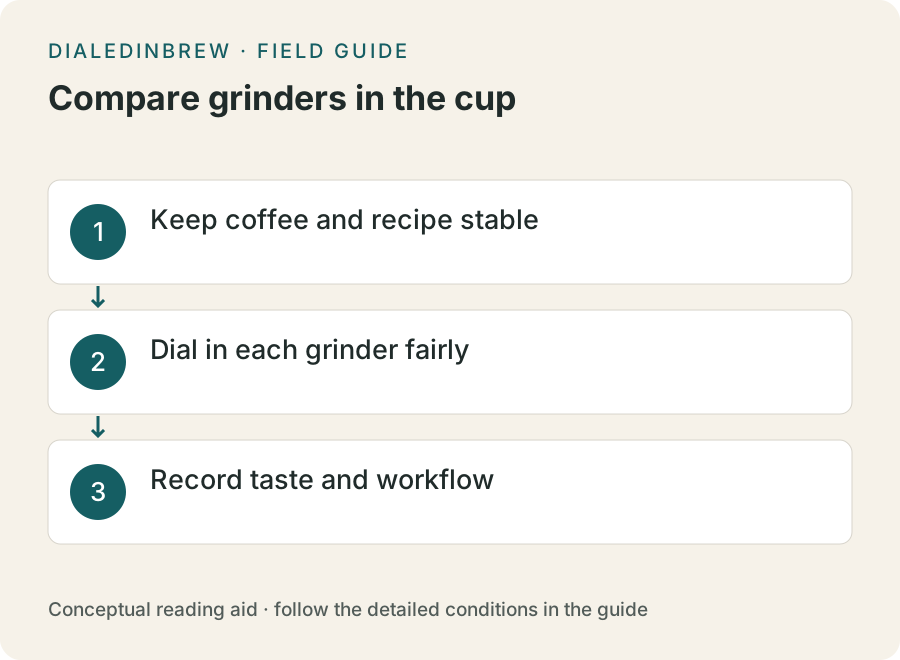
Dial each grinder in separately before comparing cups. Note retention, consistency, noise and ease of adjustment as well as flavor. A tasting observation is useful for choosing equipment, but it is not a measured particle-size distribution.
- Keep coffee and recipe stable
- Dial in each grinder fairly
- Record taste and workflow
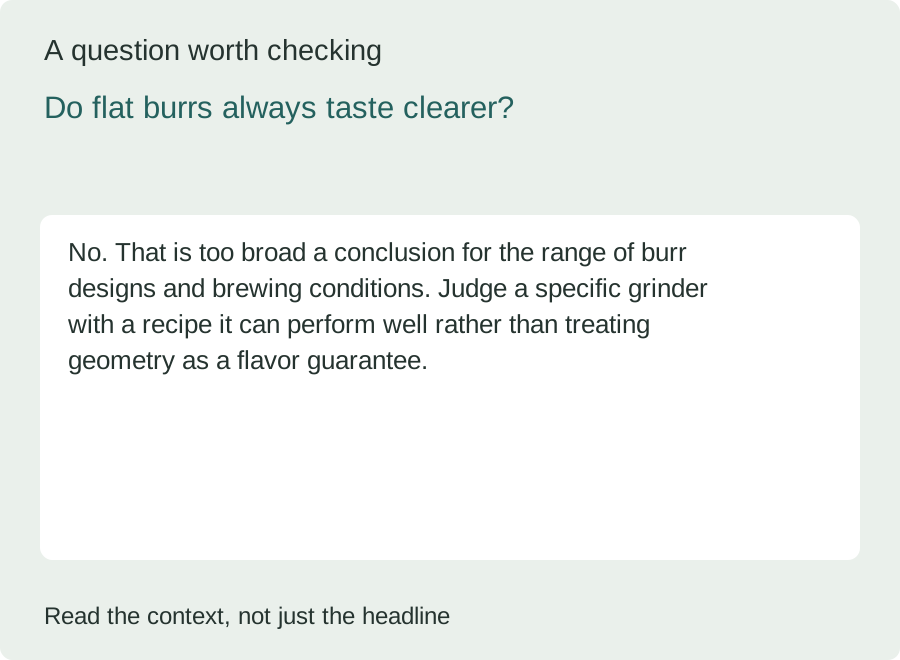
Do flat burrs always taste clearer?
No. That is too broad a conclusion for the range of burr designs and brewing conditions. Judge a specific grinder with a recipe it can perform well rather than treating geometry as a flavor guarantee.
For more context, see the topic FAQ and glossary. A reference value or example should be read with its units, assumptions and product-specific conditions.
Sources and scope
The references below were supplied with the original manuscript. A reference is not evidence that every numerical claim has been independently checked. See the source library and our verification status.
- Cameron et al. – Systematically Improving Espresso: Insights from Mathematical Modeling and Experiment (Matter, Cell Press)
- Uman et al. – The effect of bean origin and temperature on grinding roasted coffee (Scientific Reports, Nature)
- Cordoba et al. – Coffee extraction: A review of parameters and their influence on physicochemical characteristics and flavor (Trends in Food Science & Technology)
Put the explanation to work
Continue reading
Spot a questionable claim or a calculation issue? Read our correction process and contact information. Examples and illustrations are educational; they do not establish product suitability or a laboratory result.