 Cup & Ratio
Grind Particle Physics & Burr Geometry
Espresso flow, fines and channeling
A fast shot can come from a coarse grind, poor distribution, an unsuitable dose or several factors together.
Before you start
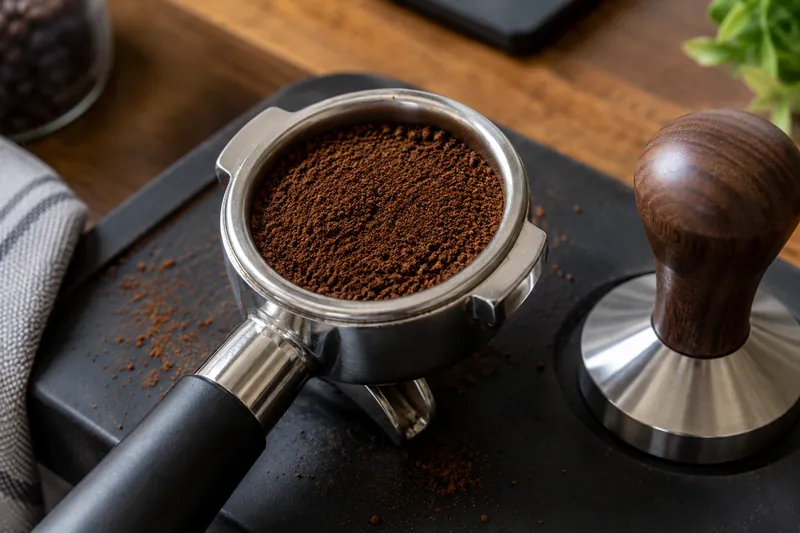
A fast shot can come from a coarse grind, poor distribution, an unsuitable dose or several factors together. Start with a consistent basket preparation routine and a known recipe. A dramatic spray from a bottomless portafilter suggests a flow problem but does not identify its only cause.
Every barista is taught a simple rule on day one: “If the espresso shot runs too fast, grind finer; if it runs too slow, grind coarser.” For decades, the industry assumed that grinding progressively finer always increased total surface area, slowed down the shot, and monotonically increased Extraction Yield (EY%) until the machine choked.
In 2020, fluid dynamics researchers and coffee physicists (Cameron et al., Matter) proved that this assumption breaks down completely inside a real espresso puck. Once you grind finer than a critical threshold (D_50 ≈ 210–240 µm, depending on burr geometry and pressure), average extraction yield stops rising, peaks, and plunges downward—while shot-to-shot inconsistency explodes. Understanding why requires examining Darcy’s Law for porous media, Kozeny-Carman permeability, and pressure-induced fines migration. You can cross-check espresso grind targets and extraction yields in our Coffee Extraction Yield (EY%), TDS & Brew Ratio Compass and Grind Micron Matrix.
1. Darcy’s Law and Kozeny-Carman Permeability in a Coffee Puck
An espresso puck is a cylindrical packed bed of porous, polydisperse particles of cross-sectional area A (typically 26.4 cm^2 for a 58 mm basket) and depth L (typically 14–18 mm). When hot water of dynamic viscosity µ (roughly 0.305 mPa·s at 93°C) is driven across the puck by a pressure differential Δ P, the volumetric flow rate Q (mL/s) follows Darcy’s Law:
Q = (k · A · Δ P) / (µ · L)Here, k (in m^2) is the intrinsic hydraulic permeability of the coffee bed. According to the Kozeny-Carman equation, the permeability k of a packed bed of particles with effective Sauter mean diameter d_eff and bed porosity (void fraction) ε is:
k = \frac{d_eff^2 · ε^3}{180 · (1 - ε)^2}Look carefully at the two exponents in the Kozeny-Carman relationship:
- Permeability
kis proportional tod_eff^2(the square of the effective particle size, which is heavily weighted toward the sub-100 µmfines fraction). - Permeability
kis proportional to(ε^3) / ((1 - ε)^2). Because porosityεis typically around0.40in a tamped puck, even a tiny 5% reduction in void fractionε(from0.40to0.35) causes the porosity term(ε^3) / ((1-ε)^2)to drop from0.178to0.101—cutting hydraulic permeability nearly in half!
2. Why 9–12 Bar Pressure Can Actually Reduce Flow Rate (Q)
In a rigid bed of glass beads, doubling the pressure Δ P in Darcy’s Law doubles the flow rate Q. Why doesn’t a coffee puck behave like glass beads? Because hot, wet coffee grounds are viscoelastic and deformable, and sub-100 µm cellulose fines are free to move inside the interstitial pores:
- Hydraulic Bed Consolidation: When a rotary or vibration pump slams the top of the puck with
9 to 11 bar(900–1,100 kPa) of water pressure, that mechanical load is transmitted down through the solid particle skeleton toward the bottom of the stainless steel basket. The wetted coffee particles at the bottom of the puck deform and squash together, collapsing the local porosityεright above the basket holes. - Fines Migration and Filter Cake Blinding: High fluid drag forces entrain loose sub-
100 µmfines and sweep them downward until they lodge inside the narrow pore throats at the bottom of the puck, forming an ultra-dense, low-permeability compacted lamina (1–2 mmthick) directly over the basket perforations.
Because both bed consolidation and fines jamming cause k to shrink faster than Δ P grows above \sim 6–7 bar, increasing pump pressure from 6 bar to 10 bar often decreases or stalls flow rate while dramatically increasing the risk of localized puck rupture (channeling).
3. The “Volcano” Curve: Why Grinding Too Fine Lowers Extraction Yield
What happens when you keep grinding finer below the critical permeability threshold? As the compacted bottom layer becomes nearly impermeable, the 9-bar water column takes the path of least resistance—punching microscopic wormholes and high-velocity bypass channels through any slight density flaw in the puck.
Once a micro-channel opens:
- Inside the narrow channel (
5%–15%of puck volume): Water rushes through at high velocity, stripping out 28% to 32% of the local coffee mass, including bitter, astringent polyphenols, phenylindanes, and woody cellulose breakdown products. - In the surrounding bypassed zones (
85%–95%of puck volume): Flow drops to a stagnant trickle, leaving those grounds severely under-extracted at 12% to 15% EY, contributing sharp, sour organic acids and salty unbuffered minerals. - In the cup: The blended average extraction yield drops from
21.5%down to18.5%—and you taste both sourness and dry, harsh bitterness simultaneously (see Sensory Triangulation: Sour-Bitter Confusion vs. Astringency).
4. Comparing Espresso Pressure & Grind Regimes (18.0 g Dose)
The table below contrasts four distinct espresso hydraulic regimes across grind median (D_50), peak pump pressure, flow rate, and extraction uniformity:
| Espresso Regime | Target Grind (D_50) |
Peak Pump Pressure (Δ P) |
Typical Shot Time | Beverage Yield (M_bev) |
Average EY% |
Channeling Risk & Sensory Outcome |
|---|---|---|---|---|---|---|
| 1. Over-Fine Choked / Channeled | 180–210 µm |
9.0–10.5 bar |
38–50 s |
36.0 g (1:2.0) |
18.2%–19.4% |
Severe micro-channeling. Sour core with harsh, dry, astringent aftertaste. |
2. Classic 9-Bar Espresso |
235–265 µm |
9.0 bar |
27–31 s |
36.0 g (1:2.0) |
20.0%–21.2% |
Moderate risk. High viscosity and dense crema; requires meticulous WDT puck prep. |
3. Modern 6-Bar Flat Profile |
250–280 µm |
6.0 bar |
25–29 s |
40.0 g (1:2.2) |
21.5%–22.8% |
Low risk. Reduced puck compression allows more uniform flow and higher sweet extraction. |
4. 6-Bar Turbo / Allongé |
310–360 µm |
5.5–6.0 bar |
15–19 s |
48.0 g (1:2.7) |
23.0%–24.6% |
Minimal risk. Whole-puck laminar percolation; exceptional fruit clarity and high yield. |
5. Practical Puck Preparation Protocol to Maximize Uniformity (k)
To keep local permeability k(x,y) uniform across every square millimeter of a 58 mm basket:
- RDT (Ross Droplet Technique): Mist whole beans with
0.1–0.2 gof water before grinding to dissipate triboelectric static charges that glue fines into dense clumps. - Deep WDT with
0.25–0.35 mmNeedles: Stir from the bottom of the basket upward in overlapping spirograph circles. Avoid thick needles (> 0.5 mm), which plow trenches rather than shearing clumps apart. - Self-Leveling Tamp above
10–15 kgf: Once dry coffee grounds are compressed beyond\sim 12 kgf(26 lbs), Dry porosityεreaches a mechanical plateau—tamping harder (20 kgfvs15 kgf) does not change shot time, whereas a tilted tamp of even1.5°creates a permanent depth gradient (L) that forces water to channel down the shallow side of the puck. - Use a Top Puck Screen or Paper Filter: A
1.7 mmsintered mesh screen or top paper disperses incoming shower-screen jets, while a bottom55 mmpaper filter prevents basket-hole dead zones and stops fines from blinding the steel perforations.
Practical check: what to observe
Log dose, beverage yield, time and taste for several shots before changing the grind. If an adjustment improves one shot but variability remains high, work on repeatability first. Do not infer local extraction across the puck from a single average TDS measurement.
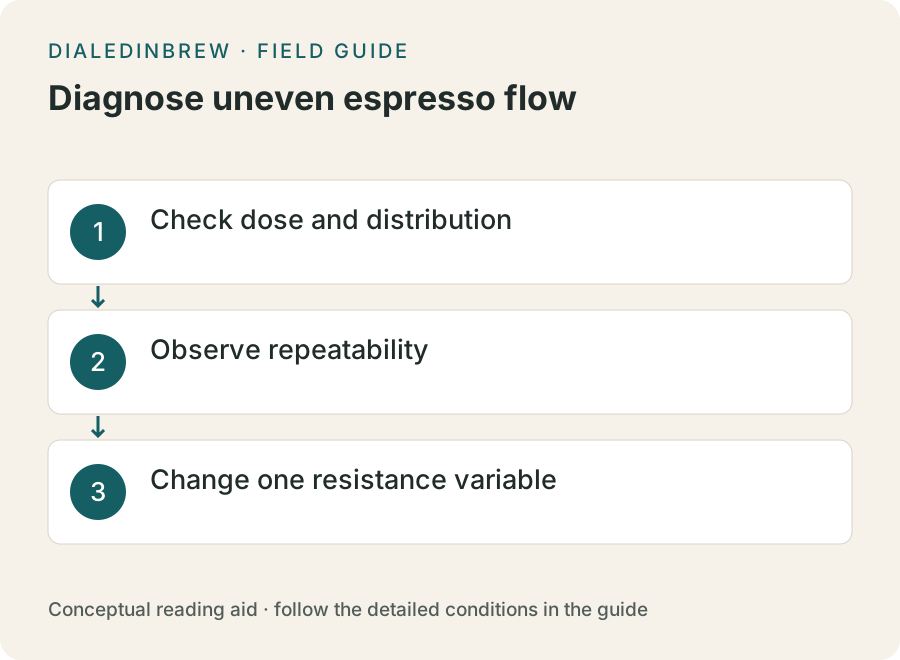
- Check dose and distribution
- Observe repeatability
- Change one resistance variable
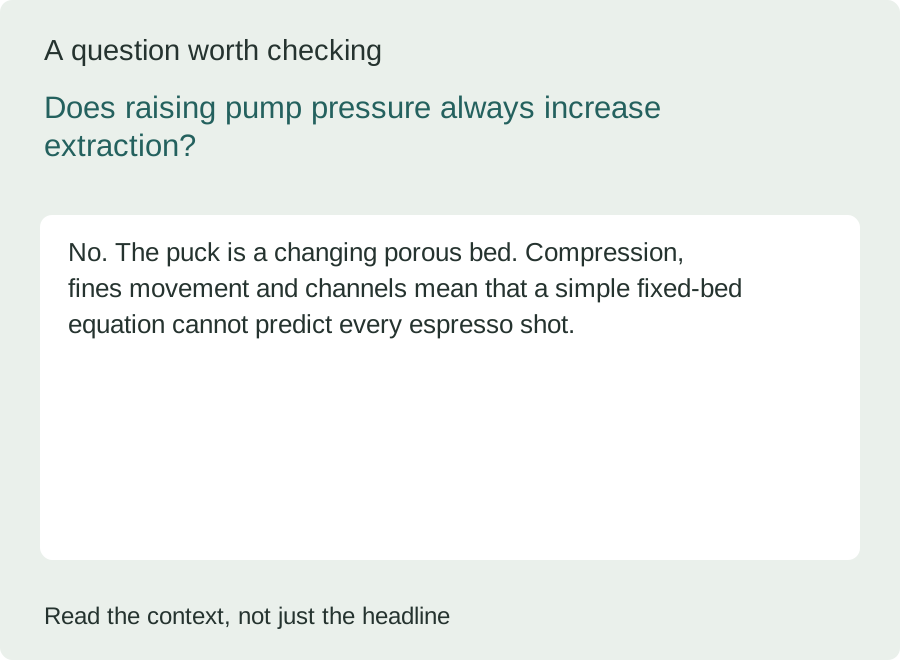
Does raising pump pressure always increase extraction?
No. The puck is a changing porous bed. Compression, fines movement and channels mean that a simple fixed-bed equation cannot predict every espresso shot.
For more context, see the topic FAQ and glossary. A reference value or example should be read with its units, assumptions and product-specific conditions.
Sources and scope
The references below were supplied with the original manuscript. A reference is not evidence that every numerical claim has been independently checked. See the source library and our verification status.
- Cameron et al. – Systematically Improving Espresso: Insights from Mathematical Modeling and Experiment (Matter)
- Corrochano et al. – A new approach to model the hydraulic permeability of coffee beds (Journal of Food Engineering)
- Mo et al. – Uneven extraction in coffee brewing: Physics of fluids in porous media (Physics of Fluids, AIP)
Put the explanation to work
Continue reading
Spot a questionable claim or a calculation issue? Read our correction process and contact information. Examples and illustrations are educational; they do not establish product suitability or a laboratory result.