 Cup & Ratio
Roast Chemistry, Thermal & Filter Mechanics
Coffee brewing temperature: a controlled comparison
A kettle setting does not equal the temperature throughout a coffee bed.
Before you start
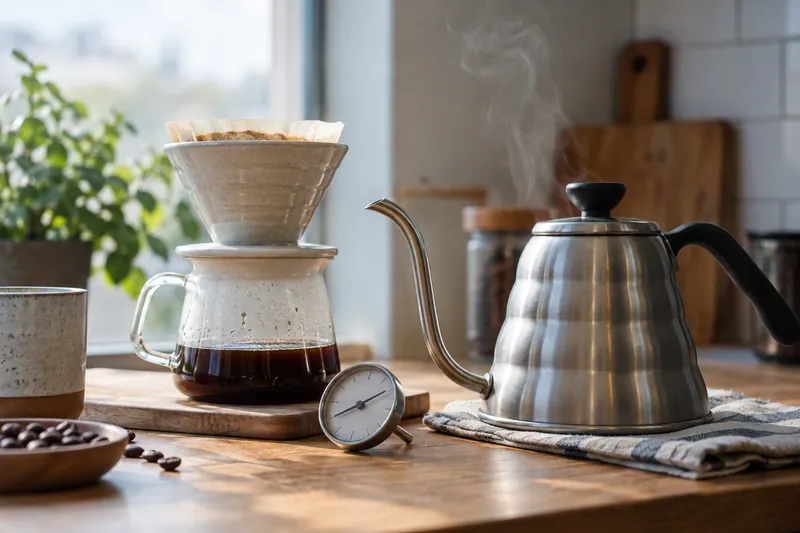
A kettle setting does not equal the temperature throughout a coffee bed. Brewer material, room conditions and pouring all affect the slurry. When comparing temperatures, keep dose, water mass, grind and pour pattern as consistent as practical, then record what actually changes.
Walk into three specialty coffee shops and you will hear three conflicting philosophies on brew water temperature: one barista boils the kettle to 99°C for every light-roast pour-over, another caps all brews at 90°C to avoid bitterness, and a third starts the bloom at 94°C and drops the kettle to 82°C for the final pour.
Who is right? Chemical analysis of coffee extracts using High-Performance Liquid Chromatography (HPLC) and Gas Chromatography-Mass Spectrometry (GC-MS) reveals that brew temperature does not merely speed up or slow down overall extraction yield (EY%) uniformly. Instead, because different classes of soluble compounds inside roasted coffee have radically different molecular polarities and enthalpies of solvation (Δ H_solv), changing slurry temperature shifts the chemical ratio of acids to sugars to bitter phenolics even when two cups are brewed to the exact same TDS and EY%!
1. Kettle Temperature vs. Actual Slurry Temperature: The Thermal Budget
Before analyzing compound solubility, we must distinguish Kettle Setpoint (T_kettle) from Coffee Slurry Temperature (T_slurry). When hot water leaves a gooseneck spout, it loses thermal energy through three mechanisms:
- Convective & Evaporative Cooling in the Pour Stream: Falling
8–12 cmthrough20°Cair cools a thin pour stream (5 g/s) by2.0°Cto3.5°Cbefore it ever touches the coffee bed. - Thermal Mass of the Dripper: A cold ceramic V60 (
320 g, specific heatc_p ≈ 0.84 J/g·K) absorbs up to6.5 kJof heat when warming from21°Cto85°C—enough to drop the temperature of a50 gbloom by12°Cto16°C! By contrast, a thin plastic or double-walled vacuum metal dripper (65 g) absorbs less than0.9 kJ. - Thermal Mass of the Dry Coffee Grounds: Heating
15 gof room-temperature coffee grounds (c_p ≈ 1.45 J/g·K) drops initial bloom water temperature by another1.5°C.
Consequently, pouring 96°C kettle water into a preheated plastic V60 typically produces a peak slurry temperature of 90.5°C to 92.0°C, whereas pouring into an un-preheated ceramic dripper drops peak slurry temperature to 84.0°C to 86.5°C.
2. Arrhenius Kinetics and Compound-Specific Solubility Curves
Both the thermodynamic equilibrium solubility (C_sat) and the effective diffusion coefficient (D_eff) of a coffee molecule follow Arrhenius and Stokes-Einstein temperature relationships:
D_eff(T) = D_0 exp(-(E_a) / (R · T)) ∝ (T) / (µ(T))As water temperature rises from 80°C (353 K) to 98°C (371 K), the dynamic viscosity of water (µ) drops by 21% (from 0.354 mPa·s to 0.282 mPa·s), accelerating diffusion for all compounds. However, the activation energy of dissolution (E_a) varies dramatically across the four major chemical families in roasted coffee:
A. Low-Molecular-Weight Polar Organic Acids (Citric, Malic, Lactic, Acetic)
- Molecular Weight:
60–192 g/mol - Polarity & Solubility: Highly polar, water-soluble across all temperatures (even in
20°Ccold brew!). - Extraction Window: Over 80% to 90% of extractable citric and malic acids dissolve during the first
45–75 secondsof brewing, regardless of whether the slurry is at83°Cor95°C.
B. Sucrose, Simple Carbohydrates & Early Maillard Intermediates
- Molecular Weight:
180–600 g/mol - Polarity & Solubility: Moderately high solubility, with peak diffusive extraction occurring in the
88°Cto94°Cslurry range during the middle phase of percolation.
C. Chlorogenic Acid Lactones, Phenylindanes & Dark-Roast Pyrolysis Phenols
- Molecular Weight:
330–1,500+ g/mol - Polarity & Solubility: Larger, less polar aromatic ring structures with a high enthalpy of solvation (
E_a). - Extraction Window: Poorly soluble below
85°C, but extraction accelerates sharply as slurry temperature climbs above92°C. In medium-dark and dark roasts where chlorogenic acids have broken down into intensely bitter phenylindanes, brewing at96°Cpulls35%–50%more bitter phenolics than brewing at86°C!
3. Temperature Selection Matrix by Roast Level and Processing Method
Because roast development and post-harvest fermentation alter both cell-wall porosity and the concentration of bitter pyrolysis compounds, optimal kettle temperature must scale inversely with roast development and fermentation intensity:
| Bean Roast & Processing Profile | Agtron (Gourmet) | Recommended Kettle Temp (T_kettle) |
Target Peak Slurry Temp (T_slurry) |
Target Espresso PID Temp | Primary Chemical Rationale |
|---|---|---|---|---|---|
| Ultra-Light Washed (Kenya, Ethiopia, Geisha) | 78–88 |
96°C–99°C |
91°C–93.5°C |
94°C–96°C |
Dense cellulose walls and minimal phenylindanes require maximum thermal energy to extract sugars to balance high citric/malic acid. |
| Light-Medium Washed / Honey | 65–76 |
92°C–95°C |
88°C–91°C |
92°C–93.5°C |
Balances sweet caramelization intermediates against vibrant fruit acids without pulling dry woody cellulose notes. |
| Anaerobic / Thermal Shock / Heavy Natural | 62–72 |
88°C–91°C |
84°C–87°C |
90°C–91.5°C |
High cellular porosity and volatile fermentation esters over-extract easily into boozy/medicinal harshness above 93°C. |
| Medium Traditional Espresso / Drip | 52–62 |
88°C–90°C |
84°C–86°C |
90°C–92°C |
Moderates chlorogenic acid lactone extraction while highlighting chocolate, hazelnut, and brown-sugar melanoidins. |
| Medium-Dark to Dark Roast | 38–50 |
82°C–86°C |
78°C–83°C |
86°C–89°C |
Suppresses high-temperature solvation of bitter phenylindanes and smoky heterocyclic pyrolysis compounds. |
4. Two-Stage Thermal Declination (Variable-Temperature Pouring)
What if you want the high sugar and floral extraction of a 95°C brew during the first half of a pour-over, without pulling the dry, tannic polyphenols that leach out of the spent bed during the final drawdown?
By using Two-Stage Thermal Declination (popularized in World Brewers Cup routines):
- Phase 1 (0:00 to 1:30 — First
60%of Water Mass): Pour at94°C–96°Cfor the bloom and first main extraction pour, when the coffee particles are still rich in acids, aromatics, and carbohydrates. - Phase 2 (1:30 to Drawdown — Final
40%of Water Mass): Add100–150 gof room-temperature brew water directly into your gooseneck kettle to immediately drop the kettle temperature to80°C–84°Cfor the final pour. - Why It Works: During the final minute of percolation, nearly all desirable acids and simple sugars have already exited the coffee grounds; only high-molecular-weight, bitter, astringent compounds remain inside the cell walls. Dropping the slurry temperature below
83°Cshuts down the Arrhenius extraction rate of those late-eluting bitter compounds while still washing the remaining sweet interstitial liquid down into the carafe! You can track how thermal declination affects your finalTDSandEY%in our Coffee Extraction Yield (EY%), TDS & Brew Ratio Compass.
Practical check: what to observe
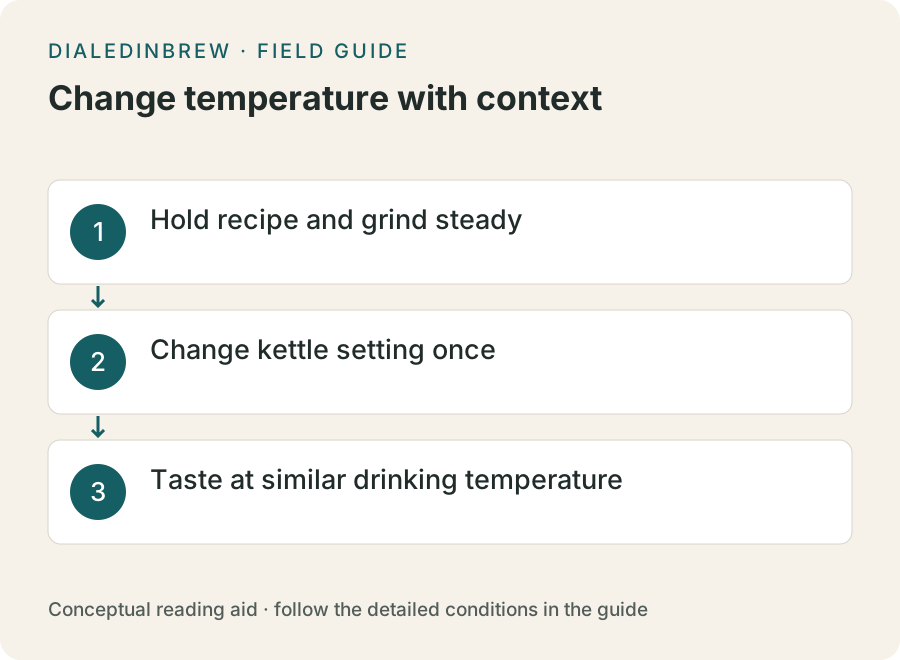
Label two cups without revealing the setting, allow them to reach comparable drinking temperatures and taste again. Record sweetness, dryness and balance rather than only hot-versus-cool. Repeat the comparison before turning one preferred cup into a general rule for a roast.
- Hold recipe and grind steady
- Change kettle setting once
- Taste at similar drinking temperature
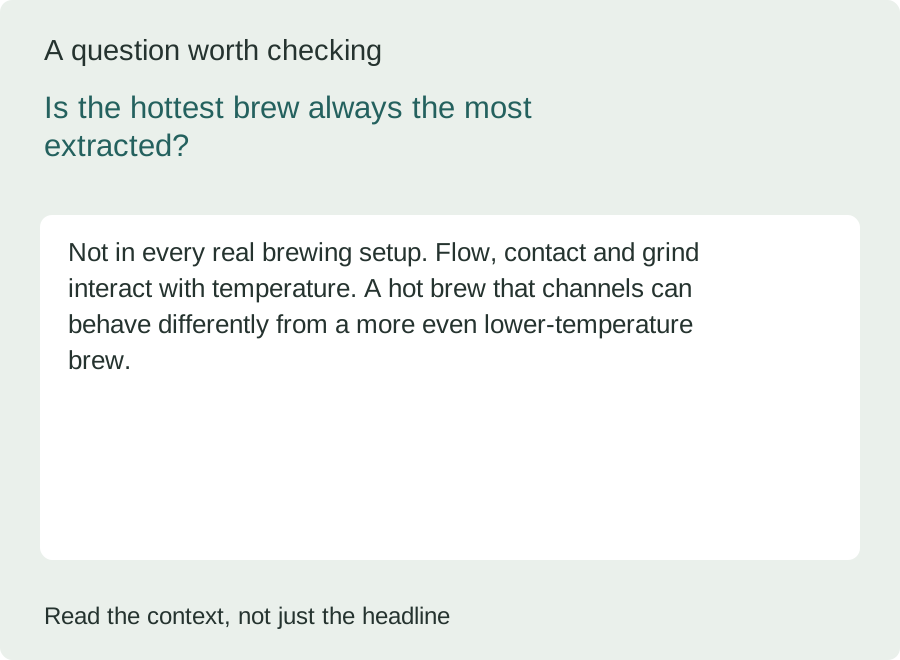
Is the hottest brew always the most extracted?
Not in every real brewing setup. Flow, contact and grind interact with temperature. A hot brew that channels can behave differently from a more even lower-temperature brew.
For more context, see the topic FAQ and glossary. A reference value or example should be read with its units, assumptions and product-specific conditions.
Sources and scope
The references below were supplied with the original manuscript. A reference is not evidence that every numerical claim has been independently checked. See the source library and our verification status.
- Batali, Ristenpart & Guinard – Brew temperature, at fixed brew strength and extraction, has little impact on the sensory profile of drip brew coffee (Scientific Reports)
- Frank, Zehentbauer & Hofmann – Bioresponse-guided decomposition of roast coffee beverage and identification of key bitter taste compounds: Chlorogenic acid lactones and phenylindanes (Eur. Food Res. Technol.)
- Salamanca et al. – Extraction kinetics of coffee aroma and non-volatile compounds across thermal gradients (Journal of Food Engineering)
Put the explanation to work
Continue reading
Spot a questionable claim or a calculation issue? Read our correction process and contact information. Examples and illustrations are educational; they do not establish product suitability or a laboratory result.