 Cup & Ratio
Roast Chemistry, Thermal & Filter Mechanics
Coffee filters: flow, paper taste and texture
A new paper can alter drawdown even when grind and pouring stay the same.
Before you start
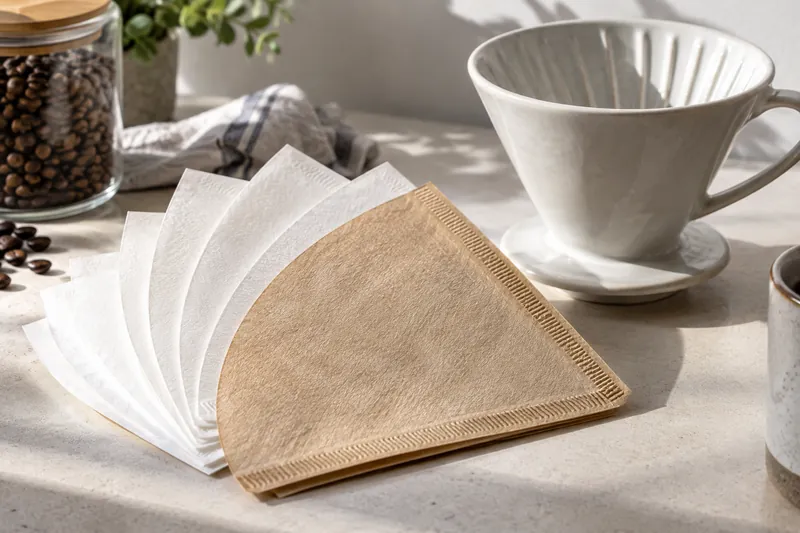
A new paper can alter drawdown even when grind and pouring stay the same. Before adjusting the grinder, check that the filter fits the brewer and has not folded into the outlet. A change in flow is a useful observation, not an automatic instruction to grind coarser by a fixed number of microns.
In percolation brewing, the paper filter is far more than a passive basket that holds coffee grounds in place. A pour-over filter paper is an active depth-and-surface filtration membrane whose cellulose fiber density, crêping geometry, and pore throat distribution (15–25 µm) directly govern two critical outcomes: first, hydraulic drawdown velocity (how quickly sub-100 µm coffee fines blind the paper pores); and second, colloidal and lipid phase separation (how much emulsified coffee oil and diterpene matter reaches your cup).
Swapping from a fast-flowing, high-crêpe abaca-blend paper to a dense, minimally crêped softwood cellulose paper on the exact same V60 cone can add 60 to 90 seconds to your total brew time—requiring a 70 to 110 micron coarser grind setting (see our Coffee Water Chemistry (GH/KH) & Grind Micron Matrix) to avoid over-extraction and channeling.
1. Cellulose Fiber Physics: Basis Weight (gsm), Crêping, and Pore Throats
Specialty coffee filter papers are manufactured from virgin softwood kraft pulp (pine, spruce, or fir cellulose fibers measuring 1.5–3.5 mm in length and 20–35 µm in width) or blended with abaca (Manila hemp) fibers, which are thinner, stronger, and less prone to swelling when saturated with 95°C water. Three structural parameters dictate how water flows through the sheet:
- Basis Weight (
g/m^2orgsm): Measures the dry mass of cellulose per square meter of flat sheet. Standard V60 and Kalita papers weigh44 to 54 gsm, whereas thick laboratory-style bonded Chemex sheets weigh85 to 102 gsm. - Sheet Thickness and Two-Sided Crêping: During papermaking, a doctor blade scrapes the wet cellulose web off a heated Yankee dryer cylinder, buckling the sheet into microscopic ridges and valleys (crêping). High-crêpe filters (
0.28–0.34 mmgauge height) hold the wet coffee cake slightly away from the smooth dripper walls and provide 30% to 45% more effective microscopic surface area, delaying pore clogging when sub-100 µmfines migrate downward. - Nominal Pore Throat Diameter (
15–25 µm): The overlapping random network of cellulose fibers forms tortuous pore throats averaging20 µm. Because the human tongue detects gritty insoluble particles larger than\sim 25–30 µm, a20 µmcellulose filter removes virtually all perceptible sediment while allowing dissolved molecules (< 0.002 µm) to pass unimpeded.
2. Bleached (White) vs. Unbleached (Natural Brown) Filter Chemistry
Why do virtually all sensory judges and competition baristas insist on bleached white filter papers rather than unbleached brown filters?
Wood pulp consists of roughly 45% cellulose, 25% hemicellulose, and 25% lignin—a complex aromatic polymer that binds wood fibers together and turns brown/yellow upon oxidation.
- Unbleached (Natural Brown) Filters: Retain residual lignin, tall oil rosin acids, and volatile lipid-oxidation aldehydes (specifically trans-2-nonenal, hexanal, and furfural—the exact molecules responsible for the smell of wet cardboard and old paperback books). When
93°Cwater contacts an unbleached filter, these water-soluble wood extractives leach continuously into the brew. Even rinsing an unbleached filter with250 mLof boiling water fails to remove all bound lignin aromatics. - Oxygen-Bleached (TCF — Totally Chlorine Free) & ECF (Elemental Chlorine Free) White Filters: Modern white coffee filters are never bleached with elemental chlorine gas (
Cl₂). Instead, mills use pressurized oxygen (O₂), hydrogen peroxide (H₂O₂), or ozone (O₃) to oxidize and strip away residual lignin before the sheet is formed. Because the lignin is removed at the pulp mill, a quick50 mLhot-water rinse leaves an oxygen-bleached white paper completely odorless and sensory-neutral.
3. Cafestol, Kahweol, and Lipid Retention Across Filtration Media
Roasted coffee beans contain 11% to 16% lipids by dry mass—predominantly triglycerides, along with up to 1.2% diterpene esters, specifically cafestol and kahweol. In nutritional biochemistry, cafestol is the most potent dietary cholesterol-elevating compound known in the human diet (acting as an agonist of the farnesoid X receptor, FXR, which downregulates bile acid synthesis and raises serum LDL cholesterol).
During brewing, hot water liberates microscopic oil droplets (0.5–10 µm) carrying dissolved cafestol and kahweol. What happens next depends entirely on your filtration medium:
- In Metal Mesh or Unfiltered Brews (Espresso, French Press, Turkish, Cupping): Perforated stainless steel baskets (
150–300 µmholes) and woven French press screens (80–150 µmmesh) allow both sub-80 µmcellulose fines and emulsified oil droplets to pass directly into the cup. These suspended lipids coat the tongue, increasing perceived viscosity, creamy mouthfeel, and lingering aromatic finish (since many volatile pyrazines and furans are lipophilic and partition into the oil phase), while delivering3.5 to 7.2 mgof cafestol per cup. - In Cellulose Paper Filters (
15–25 µmpores): Although pure oil droplets smaller than10 µmmight theoretically slip through a20 µmhole, the coffee filter cake (spent grounds) and the hydrophilic cellulose fibers trap and coalesce96%to99.2%of all coffee lipids and diterpenes, reducing cup cafestol to less than0.08 mgper cup!
4. Quantitative Comparison of Coffee Filtration Media
The table below compares six widely used filtration media across basis weight, pore rating, drawdown resistance, lipid/cafestol transmission, and sensory impact:
| Filtration Medium | Basis Weight (gsm) |
Thickness (mm) |
Nominal Pore Throat (µm) |
Relative Drawdown Speed | Lipid & Cafestol Retention | Cup Texture & Sensory Profile |
|---|---|---|---|---|---|---|
| 1. Abaca / Fast Crêped V60 Paper | 45–48 gsm |
0.29 mm |
20–24 µm |
Very Fast (1.00× baseline) |
95%–97% retained |
Crisp acidity, high flavor separation, allows finer grinds (480–550 µm) without stalling. |
| 2. Standard Tabbed Softwood V60 | 50–53 gsm |
0.23 mm |
17–20 µm |
Medium (1.20× slower) |
97%–98% retained |
Classic clean pour-over body; moderate fines sensitivity on multi-pour recipes. |
| 3. Dense Low-Crêpe Flat-Bottom (Kalita) | 52–56 gsm |
0.19 mm |
15–18 µm |
Medium-Slow (1.35× slower) |
98% retained |
Round, sweet, blended cup profile; requires careful pouring to prevent pleat sagging. |
| 4. Bonded Lab-Weight Chemex Paper | 88–100 gsm |
0.42 mm |
10–15 µm |
Slow (1.65× slower) |
99.2%+ retained |
Ultra-clean, tea-like transparency; strips all colloidal haze and heavy bass notes. |
| 5. Woven Cotton / Flannel Nel Drip | 160–220 gsm |
0.65 mm |
30–45 µm |
Fast (0.90× baseline) |
65%–75% retained |
Traps gritty fines while passing micro-emulsified oils; velvety, liqueur-like mouthfeel. |
| 6. Etched Stainless Steel Mesh Cone | N/A (Metal) | 0.15 mm |
120–180 µm |
Variable (fines-blinded) | 10%–25% retained |
Heavy body, cloudy appearance, sediment in bottom of cup; high diterpene transfer. |
5. Paper Sandwich Espresso (EPF) and Filter Rinsing Best Practices
- Always Rinse Cellulose Paper with Hot Water (
70–95°C): Rinsing serves two purposes: it flushes trace loose cellulose dust and sizing compounds out of the sheet, and it seats the paper tightly against the dripper ribs via capillary surface tension so air cannot bypass behind the cone. - Bottom Paper Filters in Espresso Baskets: Placing a die-cut
55 mmpaper filter (such as a Chemex or Sibarist fast filter) at the bottom of an espresso portafilter basket increases effective hole coverage from\sim 6%(the steel laser perforations) to100%across the bottom face of the puck—boosting extraction yield by+0.8%to+1.4%while trapping cafestol and micro-fines (see Darcy’s Law in Espresso Pucks).
Practical check: what to observe
Record filter type, rinse routine, beverage mass and taste. If comparing paper taste, use clean water and the same handling for both filters. Do not turn a kitchen tasting into a claim about measured lipid removal or health outcomes.
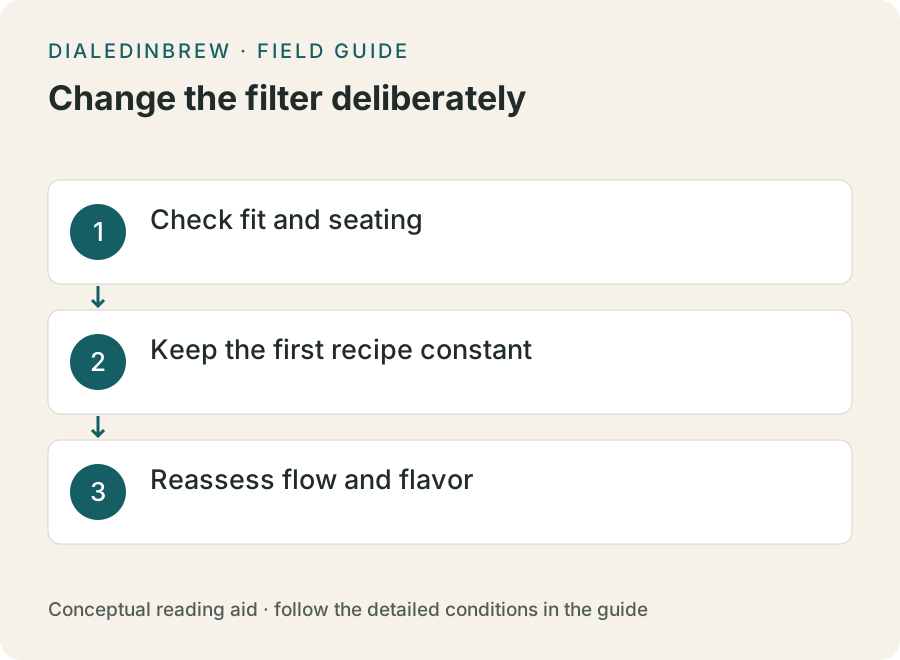
- Check fit and seating
- Keep the first recipe constant
- Reassess flow and flavor
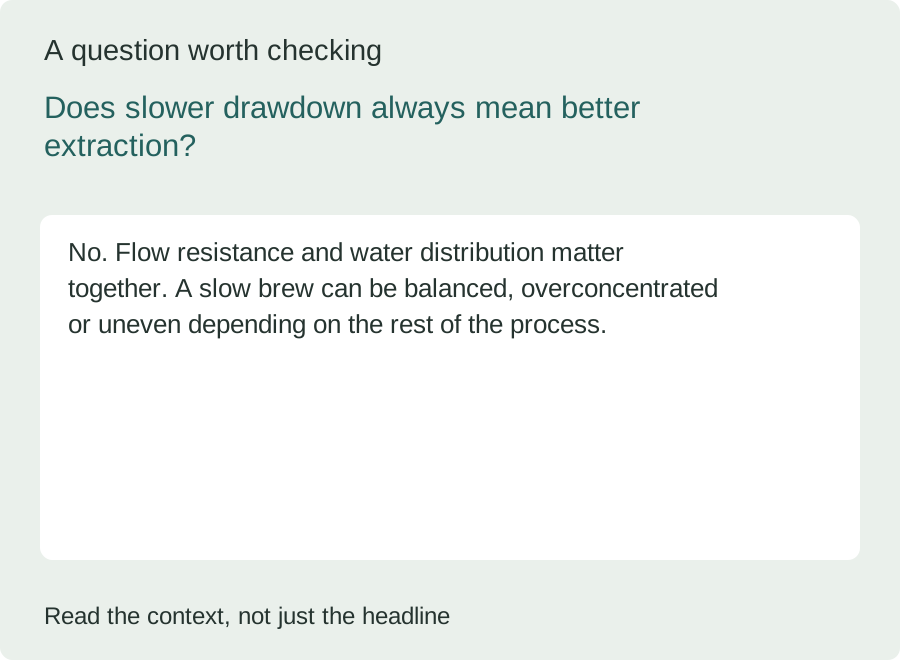
Does slower drawdown always mean better extraction?
No. Flow resistance and water distribution matter together. A slow brew can be balanced, overconcentrated or uneven depending on the rest of the process.
For more context, see the topic FAQ and glossary. A reference value or example should be read with its units, assumptions and product-specific conditions.
Sources and scope
The references below were supplied with the original manuscript. A reference is not evidence that every numerical claim has been independently checked. See the source library and our verification status.
- Urgert et al. – Levels of the Cholesterol-Elevating Diterpenes Cafestol and Kahweol in Various Coffee Brews (Journal of Agricultural and Food Chemistry)
- Zhang et al. – Retention of coffee lipids and diterpenes by cellulose paper filters of varying pore structures (Food Chemistry)
- TAPPI Standard T 410 – Grammage of Paper and Paperboard (Weight per Unit Area) & Wet Filtration Permeability
Put the explanation to work
Continue reading
Spot a questionable claim or a calculation issue? Read our correction process and contact information. Examples and illustrations are educational; they do not establish product suitability or a laboratory result.