 Cup & Ratio
Sensory Calibration & Defect Triage
Sour, bitter or dry? Coffee tasting with context
Sourness, bitterness and a drying sensation can appear together in one cup.
Before you start
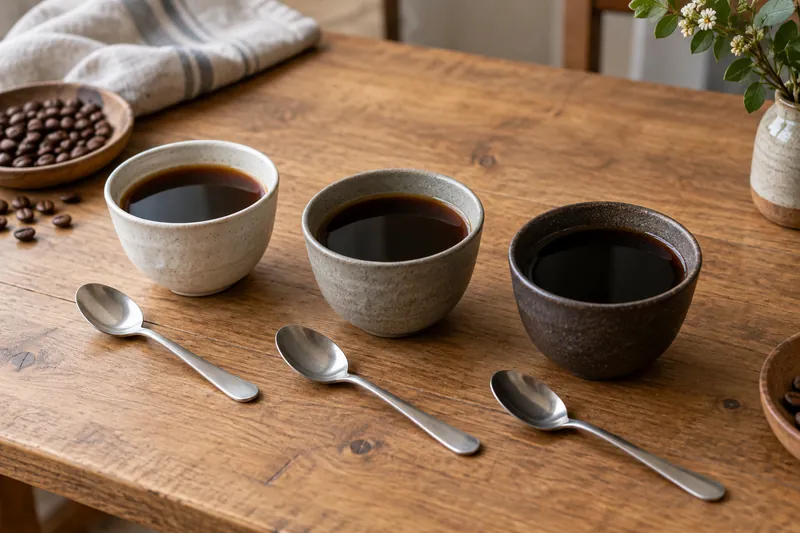
Sourness, bitterness and a drying sensation can appear together in one cup. Describe where and when you notice each rather than forcing the coffee into a single fault label. Roast character, concentration and water chemistry can all affect what you perceive.
The single most common mistake in dialing in espresso and pour-over coffee is Sour-Bitter Confusion. A barista pulls a fast or channeled shot of light-roast coffee, takes a sip, winces at an intense, unpleasant sharpness on the sides and back of the tongue, and declares: “That’s way too bitter—I need to grind coarser!” They adjust the grinder coarser, pull the next shot, and find that the unpleasant sharpness is now even more aggressive.
In sensory psychophysics, approximately 25% to 35% of untrained and semi-trained tasters systematically misclassify high-intensity sourness (free H⁺ ions) as bitterness, or conflate mechanical tannic astringency with chemical bitterness. Because fixing sourness requires the exact opposite grind adjustment from fixing uniform over-extraction, calibrating your palate across Sourness, Bitterness, and Astringency is the foundation of systematic brewing. You can map your sensory diagnosis directly to grind and yield adjustments in our Coffee Extraction Yield (EY%), TDS & Brew Ratio Compass.
1. Receptor Neurobiology: Sour vs. Bitter vs. Tactile Astringency
When you sip coffee, three completely independent sensory pathways fire inside your oral cavity:
A. Sourness (Acid Taste — Ionotropic OTOP1 Proton Channels)
- Chemical Stimuli: Free hydronium ions (
H₃O⁺) and undissociated weak organic acids (citric, malic, lactic, acetic, and phosphoric acids) that penetrate taste receptor cells and acidify the intracellular cytosol. - Temporal & Spatial Signature: Fires immediately (
0.5–2.0 seconds) upon contact, triggering rapid salivation and a sharp, electric tingle along the lateral edges of the tongue. - Extraction Timing: Because small, polar organic acids have high solubility and diffusivity (see Brew Water Temperature & Solubility), 85% of sour compounds extract during the first third of the brew.
B. Bitterness (Alkaloid & Lactone Taste — TAS2R G-Protein Coupled Receptors)
- Chemical Stimuli: Caffeine, trigonelline, chlorogenic acid lactones (formed during medium roasting), and phenylindanes (formed when chlorogenic acid lactones break down during dark roasting).
- Temporal & Spatial Signature: Slower onset (
2.5–6.0 seconds), building across the back center of the tongue and soft palate as you swallow, without causing your mouth to pucker or feel sandpapery. - Extraction Timing: While caffeine extracts early, intense roasted-bitter lactones and phenylindanes are less polar and elute heavily in the final third of extraction (and at higher slurry temperatures above
93°C).
C. Astringency (Trigeminal Mechanoreceptor Friction — NOT a Taste!)
- Chemical Stimuli: High-molecular-weight plant polyphenols, tannins, and di-caffeoylquinic acids that leach out of depleted coffee cell walls along high-velocity water channels.
- Biophysical Mechanism: Human saliva owes its slippery, velvety lubrication to Proline-Rich Proteins (
PRPs) and mucins coating the tongue and inner cheeks. When large coffee polyphenols enter the mouth, their multiple phenolic hydroxyl (-OH) groups cross-link and precipitate salivaryPRPsout of solution! - Temporal & Spatial Signature: Because the lubricating protein film on your tongue has been chemically stripped away, rubbing your tongue against the roof of your mouth feels dry, rough, papery, and sandpapery for
30 to 120 secondsafter swallowing.
2. Diagnostic Triage Matrix: Sourness vs. Bitterness vs. Channeling Astringency
Use the sensory comparison table below to diagnose any cup defect and select the exact corrective action:
| Sensory Attribute | Primary Oral Sensation | Salivary Response | Onset & Lingering Duration | Extraction Cause | Measured EY% Typical Range |
Immediate Corrective Action |
|---|---|---|---|---|---|---|
| 1. Under-Extracted Sourness | Sharp, grassy, salty-acidic bite on tongue sides; hollow middle | Triggers rapid watery salivation | Instant onset (< 2 s); fades quickly (< 10 s) with zero sweet finish |
Insufficient surface area, low temp, or short ratio | 14.0%–17.8% EY |
Grind 30–60 µm finer, increase brew ratio (+1.5 parts water), or raise temp +2°C. |
| 2. Balanced Specialty Sweetness | Juicy citrus/stone-fruit brightness wrapped in syrupy sweetness | Smooth, mouth-watering, velvety | Integrated from sip to clean, sweet 30 s finish |
Uniform laminar percolation at target yield | 19.5%–22.0% EY |
Lock in recipe; log dose, yield, grind micron, and TDS%. |
| 3. Uniform Over-Extraction Bitterness | Heavy dark-cocoa, roasted-walnut, or medicinal bitterness at back of throat | Normal lubrication (not sandpapery) | Builds after swallowing (3–8 s); lingers heavily |
Excessive contact time, too high temp on dark roast, or long ratio | 22.8%–25.0% EY |
Grind 40–70 µm coarser, shorten brew ratio, or drop kettle temp 3–5°C. |
| 4. Channeled Sour + Astringent Defect | Simultaneous sharp sour attack AND bone-dry, sandpapery finish | Strips saliva; tongue sticks to roof of mouth | Instant sour hit followed by 60+ s of dry astringency |
Localized bypass channeling (grind too fine or poor puck/bed prep!) | 17.5%–20.2% EY (deceptive average!) |
Grind slightly COARSER to restore laminar permeability (see Darcy’s Law), improve WDT, or use bypass water. |
3. Why Channeling Tricks You: The “Sour-Astringent Paradox”
Look closely at Row 4 in the table above. When an espresso puck or V60 bed channels—often because you ground too fine, causing sub-100 µm fines to blind the bottom layer and force water through wormholes—you do not get uniform over-extraction. Instead:
- The 85% of the coffee bed that water bypassed sits at
14% EY, dumping unbuffered, sharp sour organic acids and salty minerals into the cup. - The 15% of the coffee bed lining the high-velocity channel walls gets blasted to
30% EY, leaching out tannic polyphenols that precipitate your salivary proteins and leave your mouth bone-dry.
If you confuse that bone-dry, tannic finish with “uniform over-extraction” and grind way too coarse, your extraction yield plummets to 15%. Conversely, if you only notice the sourness and grind even finer on an already-choking espresso puck, the channeling gets even worse! The diagnostic giveaway of channeling is simultaneous sourness + dry sandpaper astringency.
4. The 3-Cup “Salami Shot” Calibration Exercise (15 Minutes)
The fastest way to permanently cure sour-bitter confusion and train your palate to separate early acids, mid-stage sweetness, and late-stage bitterness/astringency is to run a 3-Cup Fractional Extraction (“Salami Shot”) on either an espresso machine or a V60 pour-over:
- For Espresso (
18.0 gdose,45.0 gtotal yield over30 seconds): Line up three pre-warmed espresso cups in your hand and swap cups under the portafilter spout every10 seconds(15 gper cup):- Cup #1 (
0–10 s, first15 g,\sim 16% TDS): Concentrated organic acids, salts, caffeine, and volatile top aromas. Taste a small spoonful: notice the intense, almost battery-acid sourness and saltiness that hits the sides of your tongue immediately. This is pure under-extraction. - Cup #2 (
10–20 s, middle15 g,\sim 7% TDS): Peak carbohydrate and Maillard intermediate elution. Notice how the sharp sourness disappears, replaced by a rounded, caramel-sweet, syrupy middle. - Cup #3 (
20–30 s, final15 g,\sim 2.5% TDS): Late-eluting chlorogenic acid lactones, phenylindanes, and cell-wall polyphenols. Taste a spoonful: notice the watery body, the chemical bitterness at the back of your throat, and the dry, papery friction when you rub your tongue against your palate. This is pure late-stage over-extraction and astringency.
- Cup #1 (
- For V60 Pour-Over (
15.0 gdose,250.0 gwater): Swap three servers underneath the V60 cone at80 gcollected,160 gcollected, and220 gcollected, cool all three to45°C, and taste them in order before recombining them into a single balanced cup!
Practical check: what to observe
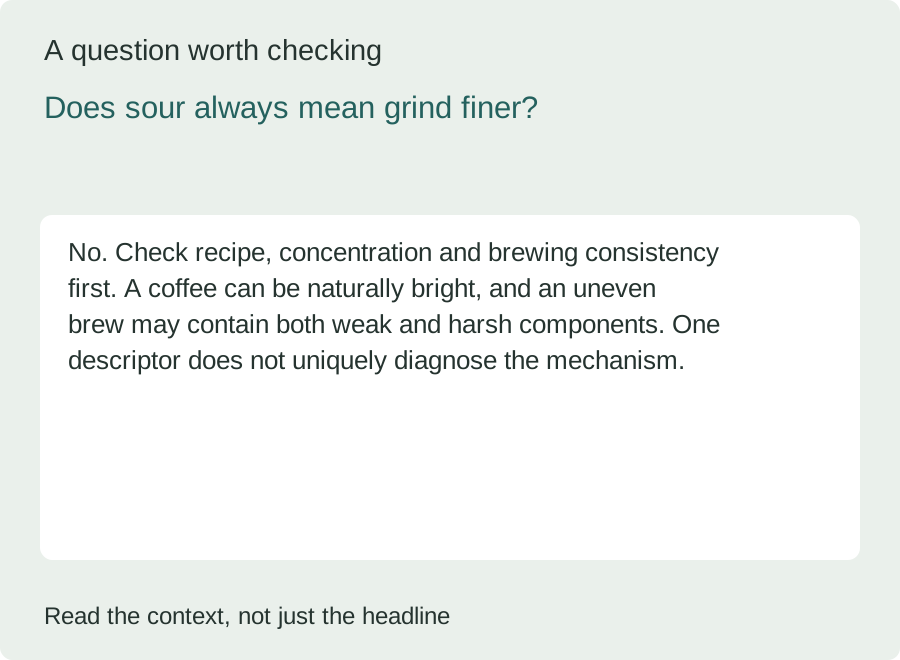
For a triangle comparison, prepare two samples of one recipe and one of another, code them and vary their order. Identifying the odd cup does not establish preference. A single successful guess is weak evidence; repeat trials before drawing a broad conclusion.
- Separate taste from mouthfeel
- Compare at equal temperature
- Repeat a blind comparison
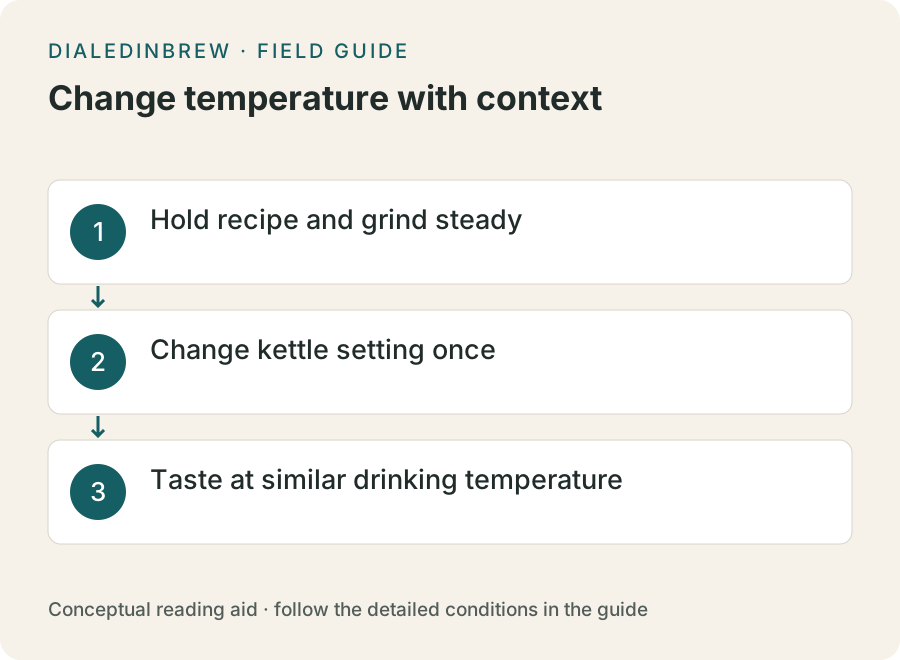
Does sour always mean grind finer?
No. Check recipe, concentration and brewing consistency first. A coffee can be naturally bright, and an uneven brew may contain both weak and harsh components. One descriptor does not uniquely diagnose the mechanism.
For more context, see the topic FAQ and glossary. A reference value or example should be read with its units, assumptions and product-specific conditions.
Sources and scope
The references below were supplied with the original manuscript. A reference is not evidence that every numerical claim has been independently checked. See the source library and our verification status.
- O'Mahony et al. – Confusion in the attribution of taste quality: Sour-bitter confusion in sensory panels (Perception & Psychophysics)
- Bate-Smith – Haemanalysis of Tannins: The Concept of Relative Astringency and Salivary Protein Precipitation (Phytochemistry)
- Batali, Cotter & Guinard – Temporal dominance of sensations and time-resolved fraction sensory profiling in drip coffee (Food Quality and Preference)
Put the explanation to work
Continue reading
Spot a questionable claim or a calculation issue? Read our correction process and contact information. Examples and illustrations are educational; they do not establish product suitability or a laboratory result.