 Cup & Ratio
Explainers
How to read a coffee study without turning it into a universal rule
Check the research question, method, measured outcome and limits before applying a coffee study to your own brewer.

Before you start
Read what a study actually measured before translating its headline into a brewing instruction. A result about concentration, a sensory panel and your own preference answer different questions. This reading worksheet helps preserve those distinctions.
Start with the outcome, not the headline
A headline may use “better coffee” while the underlying work measures something narrower. Look for the actual outcome: dissolved-solids concentration, extraction yield, a sensory rating, repeatability or a reported preference. Do not quietly replace one with another.
Our strength-versus-extraction explanation helps with two quantities that are often conflated. If you have not measured them in your own brew, describe the taste without assigning a numerical value.
Locate the original source
The Coffee Science Foundation’s Brewing Fundamentals project describes research undertaken with UC Davis Coffee Center and points readers toward the work. A project overview is a starting point. For a precise numerical claim, find the relevant publication and its method rather than citing the organization’s homepage alone.
An author’s blog can also provide useful interpretation. Keep the original research, the author’s explanation and your own conclusion distinguishable in your notes.
Use a five-question reading card
| Question | What to look for |
|---|---|
| What was asked? | The stated hypothesis or practical problem |
| What was varied? | The variable deliberately changed |
| What stayed comparable? | Coffee, brewer, water and other conditions |
| What was measured? | Units, instruments, observations or sensory method |
| Where might it not apply? | Limits, sample differences and untested conditions |
This is our editorial reading framework. It is not a quality score assigned by a research institution and does not substitute for reading the method.
Notice when an analogy is doing the work
In The Physics of Fines Migration, Gagné considers granular-physics findings in relation to coffee and explicitly discusses complications such as water forces and particle shapes. That is a useful example of keeping the connection and its limitations together.
An analogy can suggest an experiment without proving how every brewer behaves. If a simplified model helps you form a question, preserve the assumptions when explaining why you want to test it.
Turn the reading into a modest home test
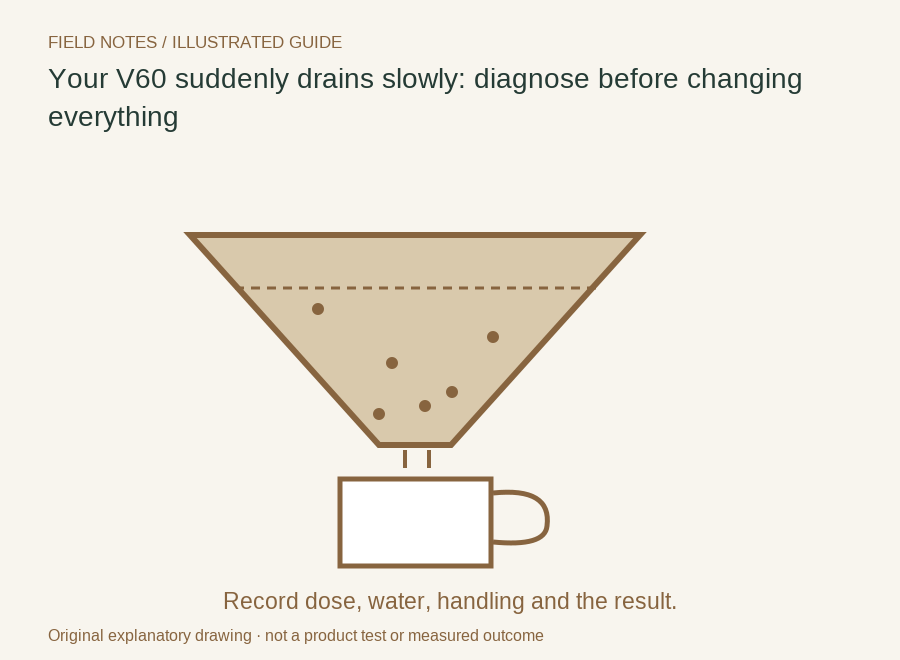
Suppose a source makes you wonder whether a handling step affects consistency. Write the baseline method and define the single change before brewing. Record multiple attempts if you want to assess repeatability. A pleasant result from one cup is a useful personal observation, but it cannot establish a general causal claim.
Use the brew journal template to separate observations from interpretations. “Drainage took longer” belongs in one field; “perhaps the handling changed flow” belongs in another.
Choose the right level of reading
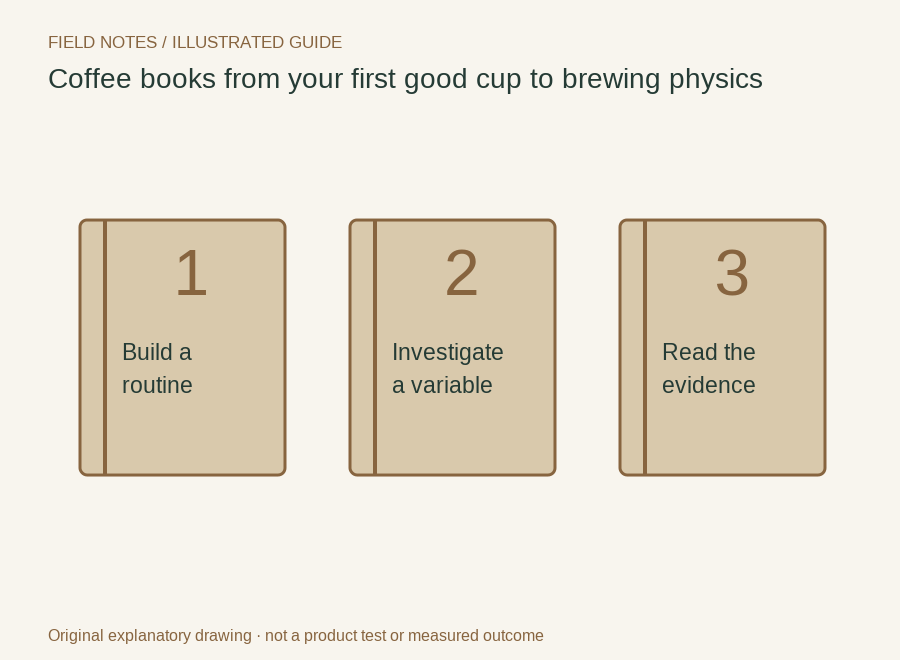
A practical book such as Hoffmann’s How to Make the Best Coffee at Home can help organize a routine. Gagné’s The Physics of Filter Coffee offers a route into deeper mechanisms. Neither title requires you to pretend that your kitchen is a laboratory.
Good reading makes your next question more precise. It also makes it easier to say what you do not yet know, without losing the pleasure of making a cup.

Practical check: what to observe
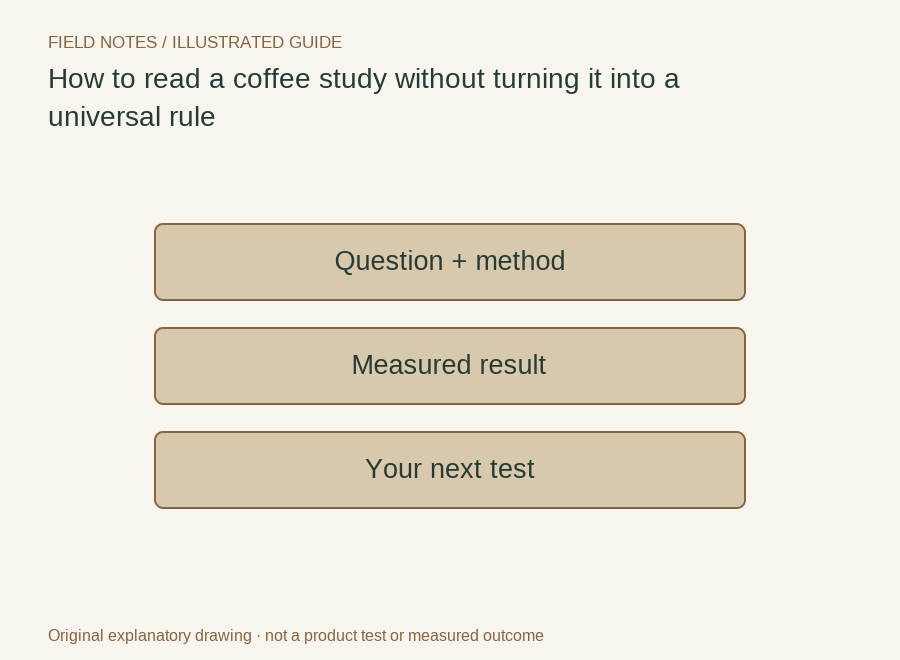
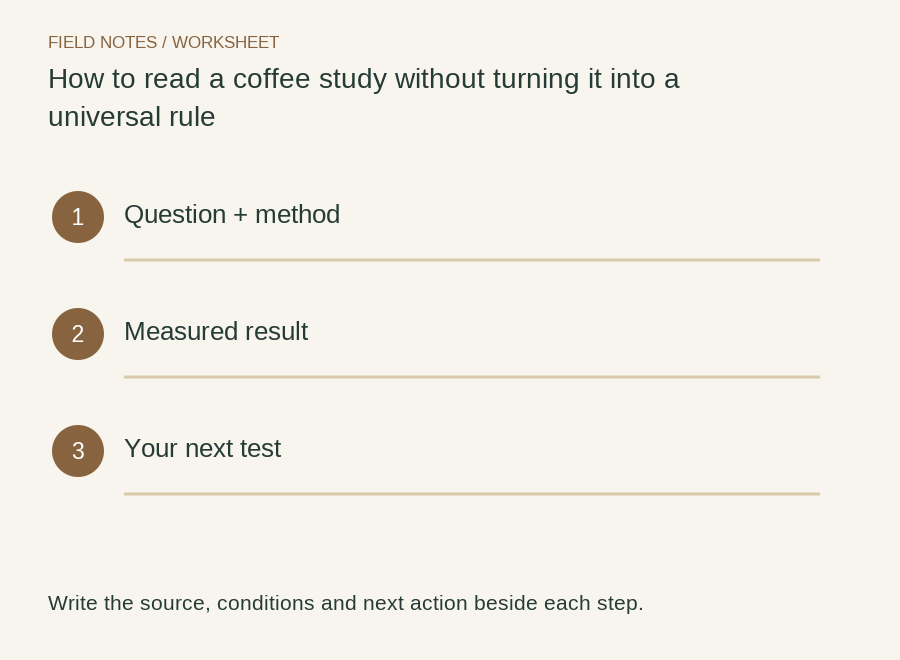
Write one sentence stating the source’s question and one stating its measured outcome. Then write a separate sentence describing what you would like to try at home. If the third sentence claims more than the first two establish, narrow it.
- Question + method
- Measured result
- Your next test
Does an expert’s name make every recommendation equally well supported?
No. Assess the specific evidence and its scope. A book, manufacturer demonstration, personal experiment and peer-reviewed study can all be useful, but they have different purposes and limitations.
For more context, see the topic FAQ and glossary. A reference value or example should be read with its units, assumptions and product-specific conditions.
Sources and scope
The reading below provides context for the relevant care or brewing principles. The article’s scenarios and decision questions are original editorial explanations, not independent product tests. Read the editorial policy for sourcing, AI assistance and corrections.
- Coffee Science Foundation — Brewing Fundamentals
Project overview with UC Davis Coffee Center; precise study claims require the individual publication.
- Jonathan Gagné — The Physics of Fines Migration
Author’s discussion of particle migration, including limits of applying idealized experiments to wet coffee.
- Jonathan Gagné — The Physics of Filter Coffee
Book page linked by the author; scope information rather than a complete review.
- James Hoffmann — How to Make the Best Coffee at Home
Publisher description establishes topics covered; no invented chapter or page citations.
Put the explanation to work
Continue reading
Spot a questionable claim or a calculation issue? Read our correction process and contact information. Examples and illustrations are educational; they do not establish product suitability or a laboratory result.