 Cup & Ratio
Explainers
Does a different water improve your coffee? Try a simple A/B comparison
Compare two drinking waters with a controlled brewing worksheet and separate a personal preference from a chemistry claim.
Before you start
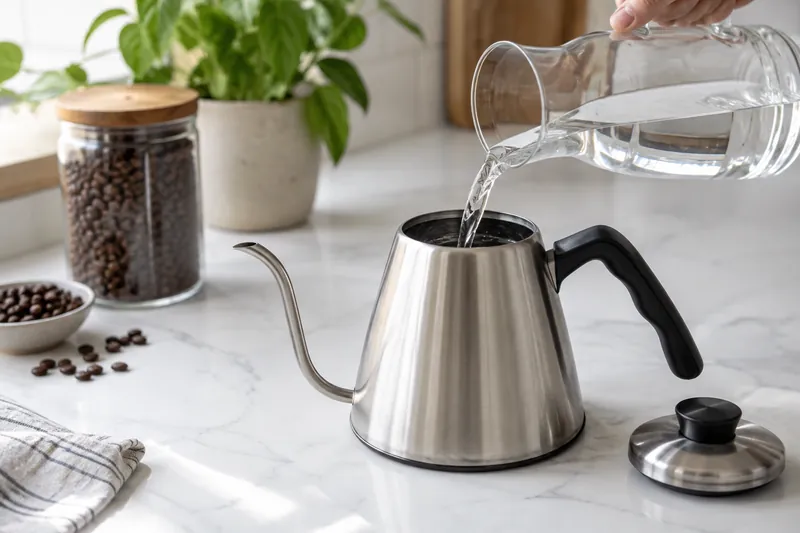
Use two suitable drinking waters, the same coffee and a recorded recipe to explore your own preference. Keep water identity hidden while tasting if practical. A small home comparison can guide your next cup, but it cannot identify an unknown mineral composition or establish a universal best water.
Define a question a home test can answer
A useful question is “Which of these two waters do I prefer with this coffee and recipe?” A much broader claim—“this water is best for coffee”—would require evidence beyond a few cups in one kitchen.
Use water suitable for drinking. For a machine with a boiler or a manufacturer’s water specification, verify compatibility before using a new water. Taste preference and equipment suitability are separate questions.
Read enough chemistry to label the comparison
Gagné’s Water for Coffee Extraction discusses mineral composition and the roles of hardness and alkalinity. It provides background for asking better questions, rather than a way to infer an unknown water’s composition from flavor alone.
Our hardness-versus-alkalinity guide introduces those distinctions. Record what is actually reported or measured, with units, and mark anything unknown.
Keep the brewing setup comparable
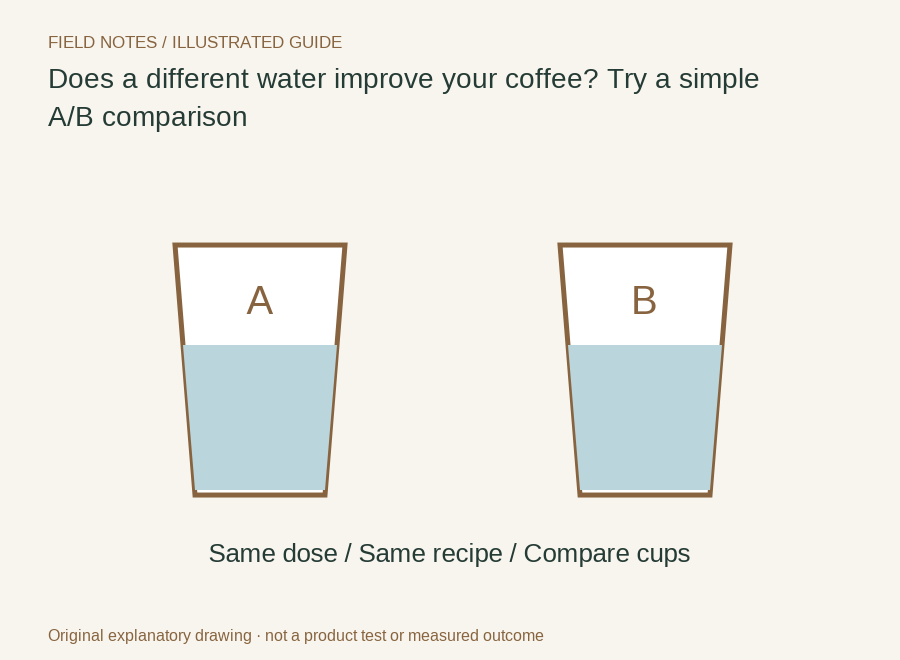
Choose a familiar manual method and a recipe you can repeat. Use the same coffee, dose, water quantity, filter and recorded technique for both cups. Prepare the comparison close enough together that storage and routine changes do not become additional questions.
| Record | Cup A | Cup B |
|---|---|---|
| Water source and date | Fill in before brewing | Fill in before brewing |
| Coffee and water mass | Same planned values | Same planned values |
| Grinder and setting | Record | Match for this comparison |
| Brewing sequence | Record | Match for this comparison |
| Tasting temperature or stage | Describe consistently | Describe consistently |
| Preference and reason | Write before revealing identity | Write before revealing identity |
This table does not guarantee laboratory control. It makes the obvious differences visible so that you can interpret the result more carefully.
Reduce expectation where you can
If another person can help, ask them to assign neutral labels without telling you which cup contains which water. Otherwise, acknowledge that you know the identities. Do not call an unblinded comparison blind.
Taste in more than one order and, if useful, repeat the comparison on another occasion. You may find a consistent preference, no clear difference or changing impressions. All three are legitimate observations; there is no need to invent a decisive winner.
Interpret a result narrowly
A preference does not identify which mineral caused it. If water sources differ in several ways, the comparison changes several components at once. It also says little about how those waters behave with another coffee or method.
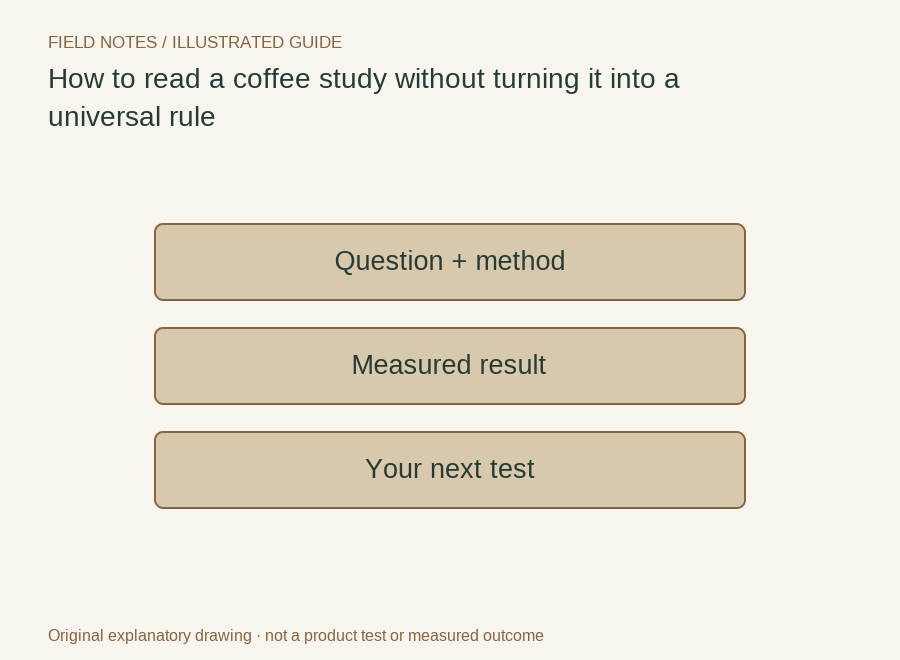
The Coffee Science Foundation’s brewing research is a route to more structured studies. Keep that distinction between a personal trial and a research finding explicit in your notes.
Use blending calculations only with known inputs
Our water blend calculator can estimate a blend from entered concentrations and volumes. It cannot measure a bottle, identify unknown contaminants or approve the water for an espresso machine.
If you prefer one of the tested waters and it is suitable for your equipment, the practical result may simply be a clearer routine. A home comparison has succeeded when it helps you make an informed choice within its limits.
Practical check: what to observe
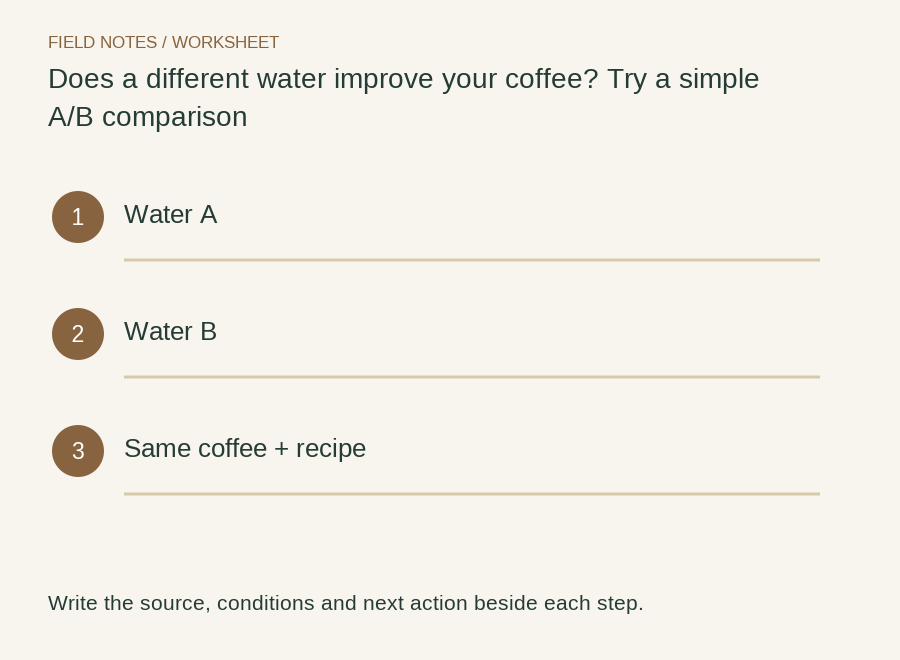
Label the two sources, record available composition information with its date and use the same brewing quantities. If possible, have another person assign neutral cup labels and reveal them after you write your observations.
- Water A
- Water B
- Same coffee + recipe
Can one TDS number tell me which water will taste better?
No. A total dissolved-solids reading does not identify all dissolved substances or separately establish hardness and alkalinity. Do not use a single number as a complete chemical description or a machine-compatibility certificate.
For more context, see the topic FAQ and glossary. A reference value or example should be read with its units, assumptions and product-specific conditions.
Sources and scope
The reading below provides context for the relevant care or brewing principles. The article’s scenarios and decision questions are original editorial explanations, not independent product tests. Read the editorial policy for sourcing, AI assistance and corrections.
- Jonathan Gagné — Water for Coffee Extraction
Background on water composition; not a laboratory analysis of a reader’s water.
- Coffee Science Foundation — Brewing Fundamentals
Project overview with UC Davis Coffee Center; precise study claims require the individual publication.
- Jonathan Gagné — Coffee ad Astra
Author background and access to articles, experiments and tools; claims are assessed individually.
Put the explanation to work
Continue reading
Spot a questionable claim or a calculation issue? Read our correction process and contact information. Examples and illustrations are educational; they do not establish product suitability or a laboratory result.