 Cup & Ratio
Extraction Physics & Yield Math
Bypass coffee math: change strength after brewing
If 200 g of coffee measures 1.50% TDS, it contains an estimated 3 g of dissolved solids.
Before you start
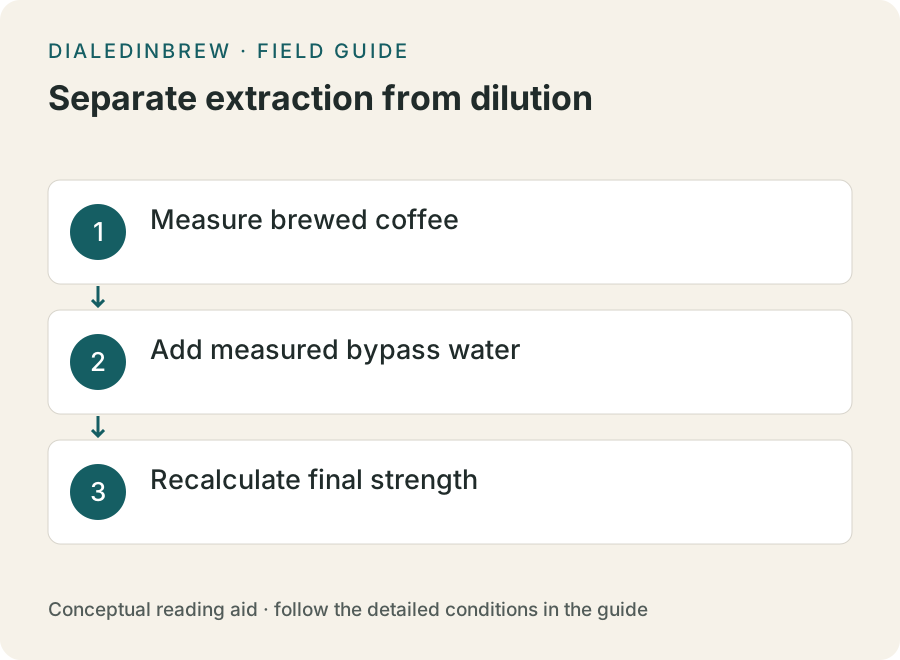
If 200 g of coffee measures 1.50% TDS, it contains an estimated 3 g of dissolved solids. Adding 50 g of plain water gives 250 g at approximately 1.20% TDS. The amount of coffee extracted has not increased; the same dissolved material is distributed through more liquid.
In standard percolation brewing, Extraction Yield (EY%) and Beverage Strength (TDS%) are mechanically locked together by your brew ratio. If you want a lighter, more tea-like beverage strength—say, dropping from 1.50% TDS down to 1.25% TDS—and you simply pour more water through the dripper (moving from a 1:15 ratio to a 1:18 ratio), that extra 45 g of hot water flows through a depleted coffee bed during the final 45 seconds of drawdown, pulling out late-eluting bitter lactones and dry, astringent polyphenols.
Bypass brewing breaks that mechanical lock. By brewing a concentrated extract with a smaller volume of Contact Water (W_contact) and then diluting the finished carafe directly with clean Bypass Water (W_bypass), you decouple how much you extract from the bean (EY%) from how strong the cup tastes (TDS%). You can calculate any bypass scenario in real time with our Coffee Extraction Yield (EY%), TDS & Brew Ratio Compass.
1. The Conservation of Solubles: Why Bypass Never Changes EY%
Recall from our guide on Percolation vs. Immersion Extraction Equations that the total mass of dissolved coffee solids inside an initial concentrated brew (M_solubles) is:
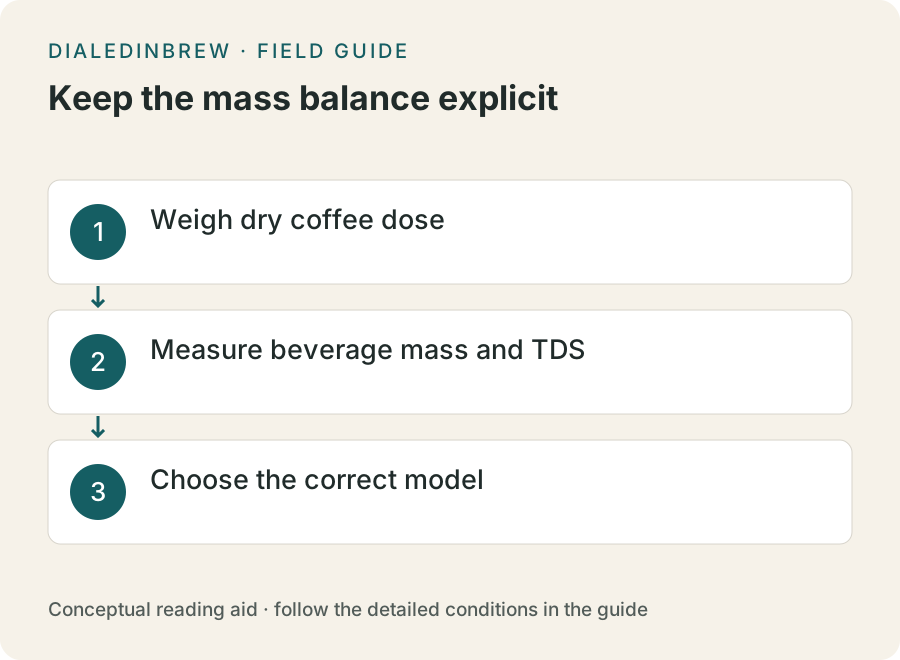
M_solubles = M_bev, initial × \frac{TDS_initial}{100}When you pour M_bypass grams of clean brew water (which contains 0.00% coffee solubles) directly into the server after removing the dripper, the mass of dissolved coffee solids inside the server (M_solubles) does not change by a single milligram! Since Extraction Yield (EY%) is defined as the total mass of extracted coffee solids divided by the dry dose (D):
EY% = \frac{M_solubles}{D} × 100 = Constant during bypass!Meanwhile, the total beverage mass increases to M_bev, final = M_bev, initial + M_bypass, so the final beverage concentration (TDS_final) scales strictly by mass conservation:
TDS_final = TDS_initial × \frac{M_bev, initial}{M_bev, initial + M_bypass}2. Exact Bypass Dilution Formula (Solving for M_bypass)
Suppose you pull an espresso, steep an AeroPress concentrate, or brew a short 1:12 pour-over, yielding an initial beverage mass M_bev, initial with measured concentration TDS_initial. How many grams of clean water (M_bypass) must you add to hit your exact desired cup strength (TDS_target)?
Rearranging the conservation equation above gives the Exact Bypass Water Equation:
M_bypass = M_bev, initial × (\frac{TDS_initial}{TDS_target} - 1)Worked Bypass Example (Concentrated V60 Hybrid to 1.32% TDS)
Suppose you want a super-sweet, zero-astringency cup of washed Colombian Caturra at 1.32% TDS and 19.8% EY:
- Dry Dose (
D):18.0 g(ground slightly finer than normal at520 µm) - Contact Water Poured (
W_contact):220.0 g(a1:12.2contact ratio) - Initial Concentrated Beverage Collected (
M_bev, initial):184.0 g - Initial Refractometer Reading (
TDS_initial):1.94% - Actual Extraction Yield (
EY_perc):(184.0 × 1.94) / (18.0) = 19.83%
Now, to dilute that 184.0 g concentrate from 1.94% TDS down to your target of 1.32% TDS, apply the bypass formula:
M_bypass = 184.0 g × ((1.94) / (1.32) - 1) = 184.0 g × (1.4697 - 1) = 86.4 gAdding 86.4 g of hot brew water directly to the carafe yields 270.4 g of finished coffee at 1.32% TDS and 19.83% EY—without ever forcing those final 86.4 g of water through the spent coffee bed!
3. Why Commercial Batch Brewers and Competition AeroPress Recipes Rely on Bypass
Bypass is not merely a rescue tool for a brew that came out too strong; it is a foundational engineering feature of high-end commercial batch brewers (such as Fetco XTS and Curtis G4 systems equipped with dedicated bypass valves) for three physical reasons:
- Preventing Bed Overflow and Excessive Drawdown in Large Batches: In a
4.0 Lcommercial batch using250 gof coffee, passing all4,000 gof water through a deep coffee bed would push total contact time past7 minutes, over-extracting the bottom of the bed and overflowing the basket. Routing25%–35%of the water through a clean bypass line keeps contact time at an ideal4:30while grinding slightly finer to preserve a20% EY. - Eliminating Late-Stage Polyphenol Astringency: As we explored in Sensory Triangulation: Sour-Bitter Confusion vs. Astringency, high-molecular-weight tannins and chlorogenic acid lactones leach out primarily during the final stage of percolation when the concentration gradient of simple sugars has collapsed. Stopping percolation early (at a
1:11to1:13contact ratio) and bypassing the rest leaves those harsh compounds locked in the filter paper. - Enabling High-Ratio AeroPress & Small-Cone Brewing: A standard AeroPress chamber holds only
240–260 mLof slurry. By steeping18 gof finely ground coffee with180 gof contact water and bypassing with90–110 gof water in the server, you can produce a full250 gmug at20.5% EYand1.35% TDS.
4. Reference Bypass Recipes Across Brewing Formats
The table below provides four calibrated bypass recipes showing exact contact water, initial concentrate specs, bypass mass, and final cup metrics:
| Brew Method & Style | Dry Dose (D) |
Contact Water (W_contact) |
Initial Yield (M_bev, init) |
Initial TDS_init |
Bypass Water Added (M_bypass) |
Final Cup Mass (M_final) |
Final TDS_final |
Locked Extraction Yield (EY%) |
|---|---|---|---|---|---|---|---|---|
| 1. Sweet V60 Bypass (Zero-Astringency Filter) | 18.0 g |
220.0 g |
184.0 g |
1.94% |
86.4 g |
270.4 g |
1.32% |
19.83% |
| 2. Competition AeroPress (Concentrate + Dilution) | 17.0 g |
170.0 g |
142.0 g |
2.15% |
88.5 g |
230.5 g |
1.32% |
21.50% (Immersion) |
| 3. Filter-Strength Americano / Long Black | 18.0 g |
62.0 g |
40.0 g |
9.20% |
226.7 g |
266.7 g |
1.38% |
20.44% |
| 4. Café Crème / Allongé Bypass | 18.0 g |
115.0 g |
90.0 g |
4.55% |
202.5 g |
292.5 g |
1.40% |
22.75% |
5. Crucial Rule: Match Your Bypass Water Chemistry!
Never bypass a coffee brewed with custom mineral water (70 ppm GH / 40 ppm KH) using unbuffered distilled water or hard municipal tap water! If you bypass with high-alkalinity tap water (KH = 130 ppm), the added bicarbonate ions will immediately neutralize the dissociated organic acids in your carafe (see Water Alkalinity (KH) and General Hardness (GH)). Always draw your bypass water from the exact same remineralized brew kettle used for your contact water.
Practical check: what to observe
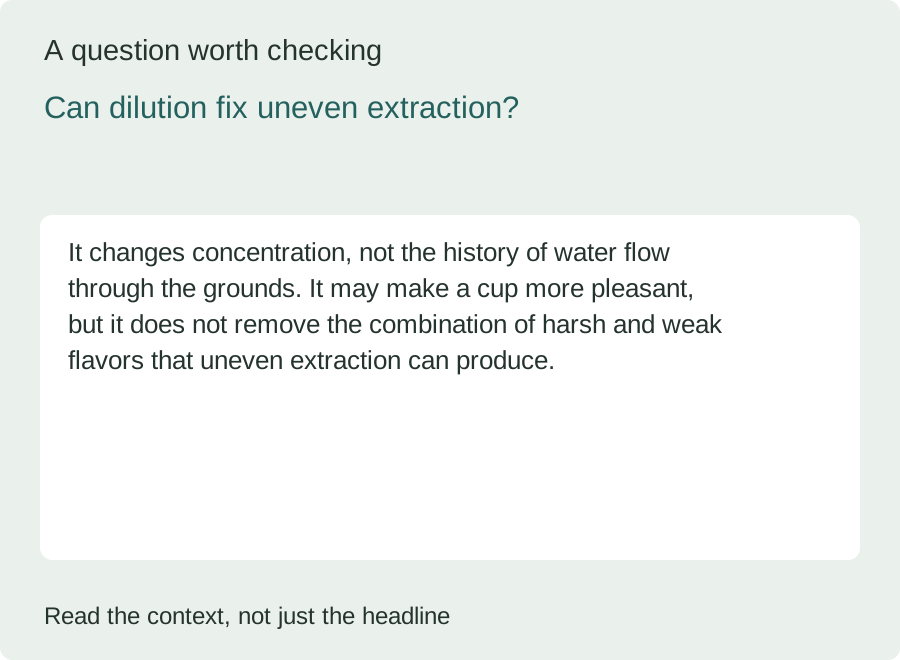
Weigh the beverage before adding water and record the added mass separately. For a clean comparison, use the same water source and comparable serving temperature. The simple calculation assumes negligible dissolved coffee in the added water and no meaningful loss during mixing.
- Measure brewed coffee
- Add measured bypass water
- Recalculate final strength
Can dilution fix uneven extraction?
It changes concentration, not the history of water flow through the grounds. It may make a cup more pleasant, but it does not remove the combination of harsh and weak flavors that uneven extraction can produce.
For more context, see the topic FAQ and glossary. A reference value or example should be read with its units, assumptions and product-specific conditions.
Sources and scope
The references below were supplied with the original manuscript. A reference is not evidence that every numerical claim has been independently checked. See the source library and our verification status.
- Lockhart – The Coffee Brewing Control Chart: Solubles Concentration vs. Extraction Yield (Coffee Brewing Institute)
- Batali et al. – Sensory and monosaccharide analysis of drip brew coffee fractions across extraction yield and TDS (Food Chemistry)
- Frost et al. – Full-immersion vs. drip-percolation mass balance and dilution dynamics (Journal of Food Science)
Put the explanation to work
Continue reading
Spot a questionable claim or a calculation issue? Read our correction process and contact information. Examples and illustrations are educational; they do not establish product suitability or a laboratory result.